
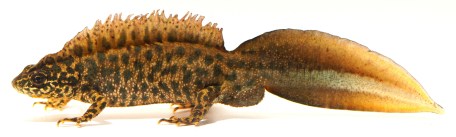
 Male crested newt of the T. karelinii-group (now called T. ivanbureschi). Picture by Michael Fahrbach.
The Triturus karelinii-group of crested newts has sometimes been considered to comprise two species, ‘T. karelinii proper’ in the east and ‘T. arntzeni’ in the west. Three hypotheses on the position of the boundary between the two have been suggested 1) somewhere in Thrace, 2) aligning with the sea strait system separating Europe and Asia, or 3) somewhere in western Anatolia. In a paper published in Amphibia-Reptilia we analysed allozyme data from Europe and north-western Turkey. We identified an eastern and a western group, in line with a two species treatment. These two groups show genetic admixture in western Anatolia, in line with hypothesis 3. However, the transition between the species is messy and unfortunately the eastern group is undersampled. Furthermore, two deeply divergent mitochondrial DNA clades suggest the transition between the two groups should be positioned further to the east. More questions than answers! Obviously, a more detailed survey on the crested newts of the Triturus karelinii-group is required.
Reference: Arntzen, J.W., Wielstra, B. (2010). Where to draw the line? A nuclear genetic perspective on proposed range boundaries of the crested newts Triturus karelinii and T. arntzeni. Amphibia-Reptilia 31(3): 311-322.


 Wielstra Lab
Pingback: Genetic differentiation in a single crested newt species | Ben Wielstra