
Within the crested newt assemblage, known as the Triturus cristatus superspecies, T. karelinii has been severely understudied. Limited data suggests there might me more than one species involved and the systematic position within the crested newt superspecies is unclear. Furthermore, T. karelinii occurs in a region that is understudied from a biogeographical point of view: the Near East. Time to take a closer look!

This ‘geophylogeny’ shows a mitochondrial DNA phylogeography for Triturus karelinii plotted on a map. Note that there are three distinct clades, with their approximate range in different shades of blue.
In a paper published in Molecular Phylogenetics and Evolution, we present a range-wide mitochondrial DNA phylogeography. We show that T. karelinii is a monophyletic group that comprises three very distinct, geographically structured lineages. They are as different from one another as recognized crested newt species are. We also provide a historical biogeographical scenario to explain the origin of these lineages.
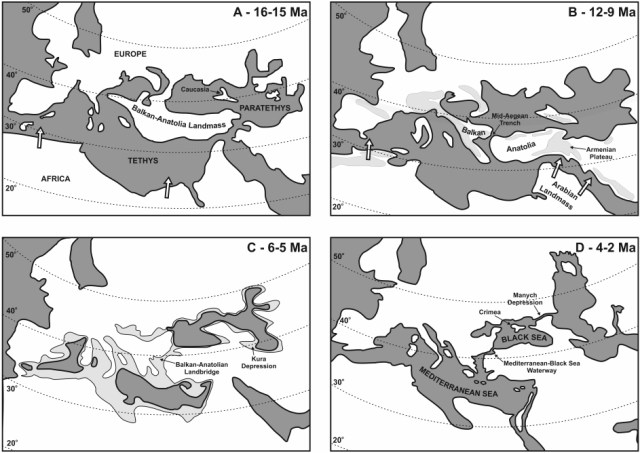
In the paper we explain the origin of the genetic variation in T. karelinii in the context of the paleogeology of Eurasia.
Reference: Wielstra, B., Espregueira Themudo, G., Güclü, Ö., Olgun, K., Poyarkov, N.A., Arntzen, J.W. (2010). Cryptic crested newt diversity at the Eurasian transition: the mitochondrial DNA phylogeography of Near Eastern Triturus newts. Molecular Phylogenetics and Evolution 56(3): 888-896.


 Wielstra Lab
Pingback: Crested newt skulls | Ben Wielstra
Pingback: The Anatolian crested newt: a new species endemic to Turkey | Ben Wielstra