
Geographical groups characterised by distinct mitochondrial DNA may still belong to a single species. However, if they are also ecologically distinct, this supports their species status. In a paper published in PLoS ONE we explore ecological differences among the three crested newt candidate species constituting the Triturus karelinii-group. We show that these differences are of a similar order as those observed between recognized crested newt species. Hence, from the perspective of both mitochondrial DNA and ecology, the candidate species are as diverged as ‘real’ species, in line with our hypothesis that they represent cryptic species.
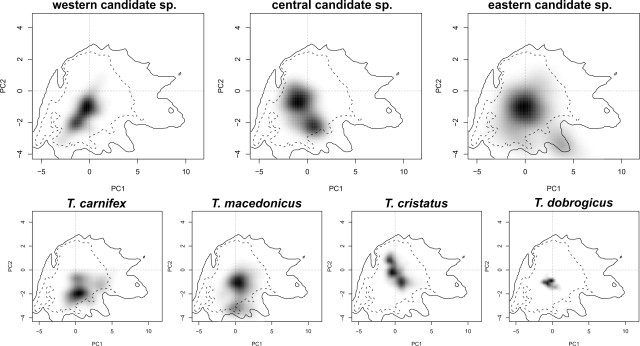 In these squares you see a two dimensional representation of the niche space experienced by all crested newts together. The grey shading reflects the occurrence of each (candidate) species within that niche space.
Reference: Wielstra, B., Beukema, W., Arntzen, J.W., Skidmore, A.K., Toxopeus, A.G., Raes, N. (2012). Corresponding mitochondrial DNA and niche divergence for crested newt candidate species. PLoS ONE 7(9): e47771.


 Wielstra Lab