
The Quaternary Ice Age heavily influenced the distribution of species. During the colder glacial periods, species went extinct in part of their range, while during warmer interglacial periods, they could recolonize these regions again. This contraction-expansion pattern left its mark on genetic diversity across species’ ranges, with high diversity in regions where species survived continuously, and low diversity in regions where they were periodically wiped out. Past range shifts can also be visualized by projecting species distribution models, based on the environmental conditions currently experienced, on climate reconstructions of the past.
In a study published in Frontiers in Zoology we explore how all the marbled and crested newts species (so the entire genus Triturus) responded to the climate change associated with the Ice Age. We conduct a phylogeographical survey, meaning we sequence a lot of mitochondrial DNA, for many populations throughout each of the species ranges, and look at variation in genetic diversity across species ranges. Additionally, we compare species distribution models projected on current and on past climate layers (the Last Glacial Maximum, about 21,000 years ago).
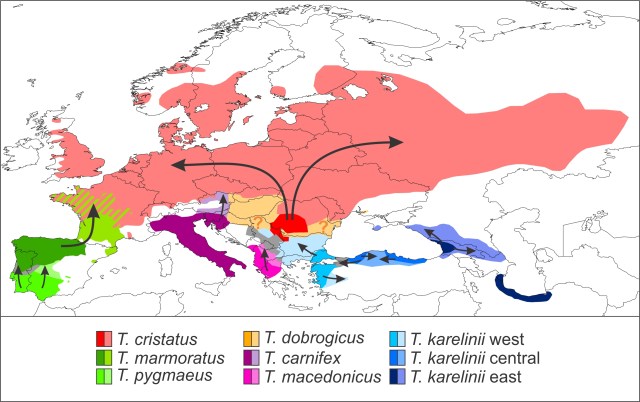
A visualization of the biogeographical scenario proposed, showing the positions of glacial refugia in dark shades and the regions postglacially colonized in light shades for each individual species. In grey areas we infer that one species displaced another as they shifted their ranges.
By combining the two independent techniques of phylogeography and species distribution modelling, we obtain a more complete understanding of the historical biogeography of the crested and marbled newts than both approaches would have provided on their own.
Reference: Wielstra, B., Crnobrnja-Isailović, J., Litvinchuk, S.N., Reijnen, B., Skidmore, A.K., Sotiropoulos, K., Toxopeus, A.G., Tzankov, N., Vukov, T., Arntzen, J.W. (2013). Tracing glacial refugia of Triturus newts based on mitochondrial DNA phylogeography and species distribution modeling. Frontiers in Zoology 10: 13.


 Wielstra Lab
Pingback: Misleading mitochondrial DNA in a Balkan crested newt | Wielstra Lab
Pingback: Refining the range dynamics of the Italian crested newt | Wielstra Lab