
Hybridizing species sometimes exchange genes in nature (a phenomenon called introgression). Introgression has particularly been documented for mitochondrial DNA. This might mean mitochondrial DNA is more susceptible to introgression, but it is also the case that researchers have simply studied mitochondrial DNA more. Usually introgression is restricted to close to the hybrid zone. There are however more pronounced examples. It does not get more extreme than in smooth newts, where the original mitochondrial DNA of Lissotriton montandoni has been completely replaced by that of L. vulgaris.

A male Lissotriton montandoni on the left and a male L. vulgaris on the right. Pictures by team Babik.
In a paper published in Molecular Ecology we extensively sample both mitochondrial and nuclear DNA for L. montandoni and surrounding L. vulgaris populations. We also use species distribution modelling to determine range dynamics of L. montandoni since the Last Glacial Maximum. We show that mitochondrial DNA introgression occurred several times, and at different moments, in different parts of the range of L. montandoni. This is probably related to the inferred range fragmentation under glacial conditions, and independent range expansion from these range fragments into L. vulgaris territory when the climate ameliorated. In contrast, there is little evidence of recent nuclear gene flow between the species.
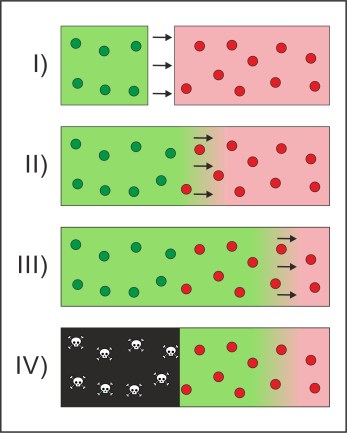
A visualization of complete mitochondrial DNA capture in response to species displacement and range reduction. We are dealing with two species here, let’s call them green and red. These species possess distinct mitochondrial DNA. Panels are ordered chronologically. In the panels, dots reflect localities, while boxes represent rough outlines of the ranges. Background shading (green or red) reflects species identity, while localities are colored according to the mitochondrial DNA type present (so dots are green or red).
In I) the ranges of the two species are geographically separated. At this stage, green mitochondrial DNA is only found in localities of the green species, and red mitochondrial DNA in localities of the red species. However, the green species is doing well for itself and, over the generations, its population increases. Surplus individuals from the right edge of the range start colonizing new localities further right. In these localities, numbers start increasing again and some offspring colonize new localities even further right, and so on. With time, the green species expands its range to the right, towards that of the red one.
In II) the ranges of the two species have come into contact. Where they meet, the two species start reproducing with one another (hybridization), resulting in offspring that are a mix of both green and red. Initially there are relatively few green individuals, but they keep pouring into the into the hybrid zone, while this is not the case for red individuals. Hybrids already present mate with these green individuals, and their offspring again mate with green individuals, and so on. Over time, individuals in the hybrid zone become ‘greener’. However, because at the initial stage of invasion by the green species most matings will concern individuals that also have red genes, some of these red genes rather than their green counterparts could locally get fixed in (introgress into) the green species by chance (and several processes that we won’t go into now might reinforce introgression). In this case mitochondrial DNA introgresses. Hence, at the right edge of the green species range, you start to see localities where individuals belong to the green species, but possess mitochondrial DNA typical of the red species (red dots in a green range).
In III) the individuals in the initial hybrid zone have become all green, except their mitochondrial DNA. Still the green species keeps expanding its range further to the right. Once again green individuals meet red ones, start hybridizing and gradually take over, and so on. In consequence, the hybrid zone between the two species moves towards the right, as the green species replaces the red species. Yet, the members of the green species at the frontier, as well as the red individuals they hybridize with, only possess red mitochondrial DNA. So the region to the right of the initial hybrid zone becomes ‘greener’, but the overturn between green and red mitochondrial DNA still aligns with that initial hybrid zone. One way to put this is that the red mitochondrial DNA ‘surfs the wave’ of the green species expansion. In effect you end up with red localities on a green background over a considerable area.
In IV) the hybrid zone between the green and the red species has stabilized at a region where the green species does not have an edge over the red species as it did before. At the same time the part of the green species’ range where it still possessed the green mitochondrial DNA type becomes unsuitable and here the green species goes extinct (black background). As a result, there are now only members of the green species left that possess red mitochondrial DNA, while the original green mitochondrial DNA has been lost.
Reference: Zieliński, P., Nadachowska-Brzyska, K., Wielstra, B., Szkotak, R., Covaciu-Marcov, S., Cogălniceanu, D., Babik, W. (2013). No evidence for nuclear introgression despite complete mtDNA replacement in the Carpathian newt (Lissotriton montandoni). Molecular Ecology 22(7): 1884-1903.


 Wielstra Lab