
During my work on the crested newt traditionally referred to as Triturus karelinii it soon became clear that more than one species is involved (although sorting out the details took a bit of time and is still not quite finished). The name arntzeni had been used before to refer to newts from the Balkan part of the range. This name was proposed in honor of my mentor Pim Arntzen. I never bought it. Not the part of Pim deserving his own newt – he most certainly does. But I did not believe that the type locality, near the small village Vrtovać in Serbia, belonged to Triturus karelinii sensu lato. It was located in such an inconvenient place, in a region where the distribution was not well understood but where I strongly suspected Triturus macedonicus would occur. We went and visit the type locality during a field trip in 2010 with Jelka Crnobrnja-Isailović. We had been joking about the identification of these newts beforehand and when we walked up to the pond judgement day had arrived. As usual there was a bit of competition of who would catch the first crested newt and as usual it was Pim who netted the first newt. I don’t remember the exact words he used when he took it out of the net but it was pretty dry and went something like “Well… that’s macedonicus…”. I have to admit I thought it all pretty funny.

Pim at the pond

These sedated newts just don’t look like karelinii
Last year we published a paper in Zootaxa where we reviewed all the available data and made clear that newts from the type locality of arntzeni strongly resembled macedonicus. So basically Pim burned his own name! Spartak Litvinchuk provided some tissue from the actual type material but this was too degraded to sequence DNA. Although DNA data from fresh material pointed towards macedonicus, arguably the amount of markers used was a bit low (and note that mitochondrial DNA is pretty useless in this region due to wide scale introgression). However, with the new Triturus Ion Torrent protocol sequencing a lot of markers for poorly preserved material suddenly became possible. In a follow-up paper, again in Zootaxa, we compared high quality genetic profiles for nine newts from the arntzeni type locality (including the holotype to which, according to the rules of taxonomy, the name is officially attached) to a comprehensive sample including all crested newt species. We got an unambiguous picture of the genetic ancestry of the Vrtovać newts: as suspected they were mostly macedonicus, but there was also a considerable amount of karelinii genes present, evidencing hybridization. These finding strongly support that the name arntzeni is not valid. Instead we introduced the name ivanbureschi and this time we made sure the type locality is nowhere near a contact zone with another species of crested newt!
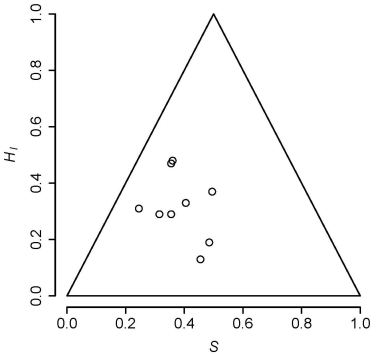
This figure might look a bit complex but sums up the genetic identity of the Vrtovać newts. The bottom left corner represents a pure macedonicus genotype and the bottom right pure karelinii (now ivanbureschi). The top of the triangle represents pure F1 (first generation) hybrids. This plot is made with the HIest R package by Ben Fitzpatrick.
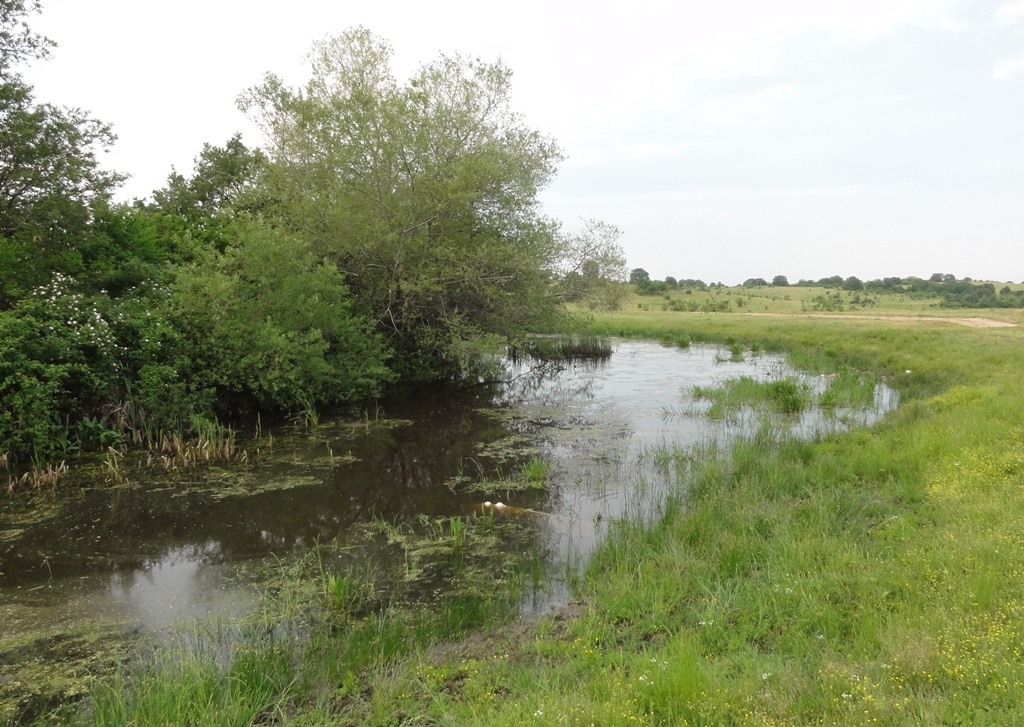
By the way, this pond is the type locality for ivanbureschi. We didn’t put this picture in the original paper, not sure why actually.
Reference: Wielstra, B., Arntzen, J.W. (2014). Kicking Triturus arntzeni when it’s down: large-scale nuclear genetic data confirm that newts from the type locality are genetically admixed. Zootaxa 3802(3): 381-388.
Reference: Wielstra, B., Litvinchuk, S.N., Naumov, B., Tzankov, N., Arntzen, J.W. (2013). A revised taxonomy of crested newts in the Triturus karelinii group (Amphibia: Caudata: Salamandridae), with the description of a new species. Zootaxa 3682(3): 441-453.



 Wielstra Lab
Pingback: The Anatolian crested newt: a new species endemic to Turkey | Ben Wielstra