
Banded newts (the genus Ommatotriton) are stunning critters. They are also distributed in a biologically fascinating, but relatively understudied region: the Near East. All the more reason to work on them, you would say. However, an in depth study on the historical biogeography of banded newts was lacking so far. There is not even consensus on how many species of banded newt there are! A banded newt phylogeography is the subject of the first paper from the thesis of my PhD student Isolde van Riemsdijk, now published in Molecular Phylogenetics and Evolution.
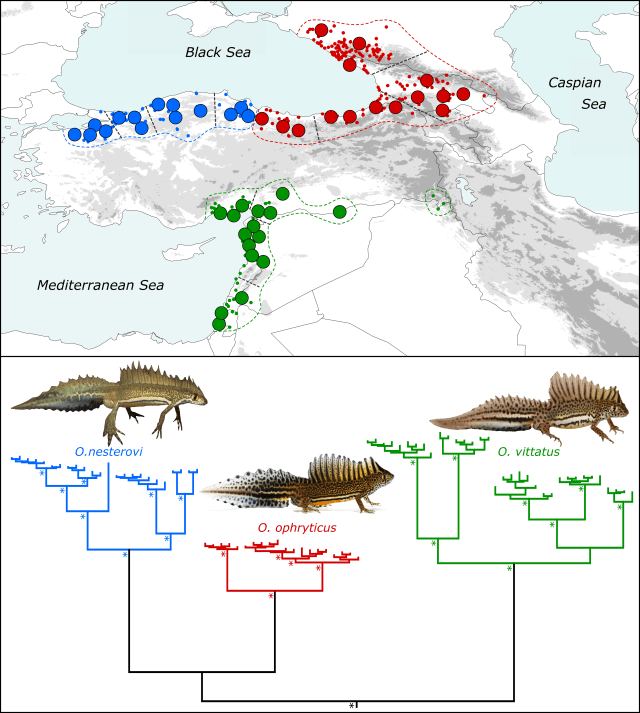
We confirm that there are three genetically distinct banded newt species, albeit relationships among these species remain unclear. One of the species, O. vittatus, is geographically completely isolated from the other two, O. nesterovi and O. ophryticus. While it seems likely that O. nesterovi and O. ophryticus meet in nature, it seems that there is little to no gene flow between the two species. The split between the three species is old, and genetic structure within species is ancient as well. The banded newt phylogeography highlights what an important region the Near East is form the perspective of biodiversity.
Reference: van Riemsdijk, I., Arntzen, J.W., Bogaerts, S., Franzen, M., Litvinchuk, S.N., Olgun, K., Wielstra, B. (2017). The Near East as a cradle of biodiversity: a phylogeography of banded newts (genus Ommatotriton) reveals extensive inter- and intraspecific genetic differentiation. Molecular Phylogenetics and Evolution 114: 73-81.

This project has received funding from the European Union’s Horizon 2020 research and innovation programme (under the Marie Skłodowska-Curie grant agreement No. 655487) and the ‘Nederlandse organisatie voor Wetenschappelijk Onderzoek’ (NWO Open Programme 824.14.014).


 Wielstra Lab
Pingback: Hybrid banded newts introduced in Spain | Ben Wielstra
Pingback: Cracking cryptic banded newt species | Wielstra Lab
Pingback: First PhD graduated from my lab | Wielstra Lab
Pingback: More resolution for the beautiful banded newts | Wielstra Lab
Pingback: Hybrid zone analysis confirms cryptic banded newt species | Wielstra Lab
Pingback: Clearing up the relationships between banded newt species | Wielstra Lab