
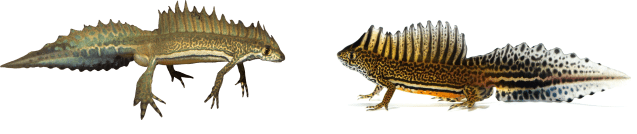
 Ommatotriton nesterovi (left) and O. ophryticus.
The introduction of species outside their native range is worrisome from the point of view of conservation, as they can negatively impact native species. Banded newts naturally occur in the Near East. Yet, an introduced population was recently discovered in Spain. In a paper published in Conservation Genetics we identify the species involved and the geographical origin of the introduced newts. We compare the genotypes of eleven Spanish banded newts with a range-wide phylogeography of banded newts. Surprisingly, all Spanish individuals turn out to be hybrids between two different banded newt species: Ommatotriton ophryticus and O. nesterovi. The ancestors of these hybrids originated from Turkey. We argue that the hybrid nature of the Spanish banded newts makes it (even) harder to predict what their impact on native species might be.
Reference: van Riemsdijk, I., van Nieuwenhuize, L., Martínez-Solano, I., Arntzen, J.W., Wielstra, B. (2018). Molecular data reveal the hybrid nature of an introduced population of banded newts (Ommatotriton) in Spain. Conservation Genetics 19(1): 249-254.



 Wielstra Lab
Pingback: First PhD graduated from my lab | Wielstra Lab
Pingback: More resolution for the beautiful banded newts | Wielstra Lab