
The New Atlas of Amphibians and Reptiles of Europe was published in 2014 in the journal Amphibia-Reptilia. In the new atlas, the ‘smooth newt’ and the Carpathian newt were mapped. It turns out that the original smooth newt comprises five different species and the Carpathian newt is a member of the ‘smooth newt Lissotriton vulgaris complex’. To reflect these new developments in smooth newt taxonomy, we used genetic data to approximate the ranges of all six species and compiled a smooth newt distribution database. Our work particularly focused on the Balkan Peninsula and the Carpathians, as here the different species meet in nature. In a paper published in Amphibia-Reptilia we provide atlas maps for the smooth newt complex.
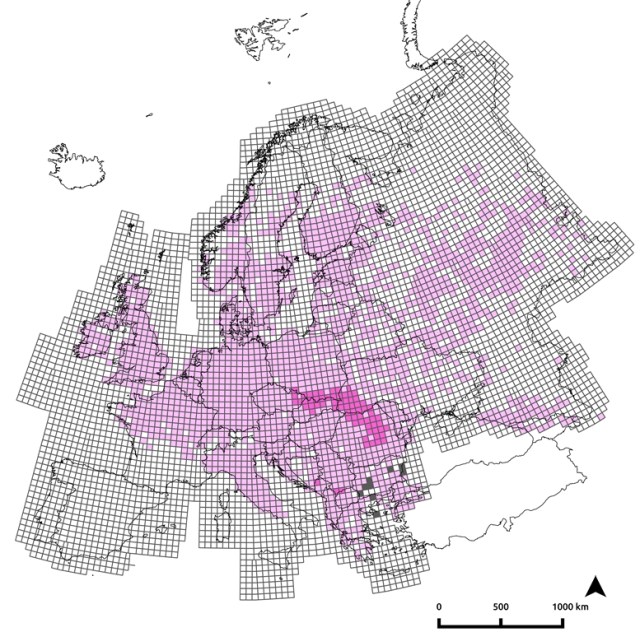
This is an overview of all the grid cells that have smooth newt localities (with cells having more than one species colored dark rather than light purple and cells for which smooth newts are present but the exact species is unknown colored grey). Maps for the individual species are published with the paper. Note that, because our maps only cover the focus area of the new atlas, part of the ranges of some species are not shown and one species that occurs completely outside of the focal area has no map.
Reference: Wielstra, B., Canestrelli, D., Cvijanović, M., Denoel, M., Fijarczyk, A., Jablonski, D., Liana, M., Naumov, B., Olgun, K., B., Pabijan, M., Pezzarossa, A., Popgeorgiev, G., Salvi, D., Si, Y., Sillero, N., Sotiropoulos, K., Zieliński, P., Babik, W. (2018). The distributions of the six species constituting the smooth newt species complex (Lissotriton vulgaris sensu lato and L. montandoni) – an addition to the New Atlas of Amphibians and Reptiles of Europe. Amphibia-Reptilia 39(2): 252-259.


 Wielstra Lab
Pingback: A genetic tool to determine if a smooth newt is male or female | Wielstra Lab