
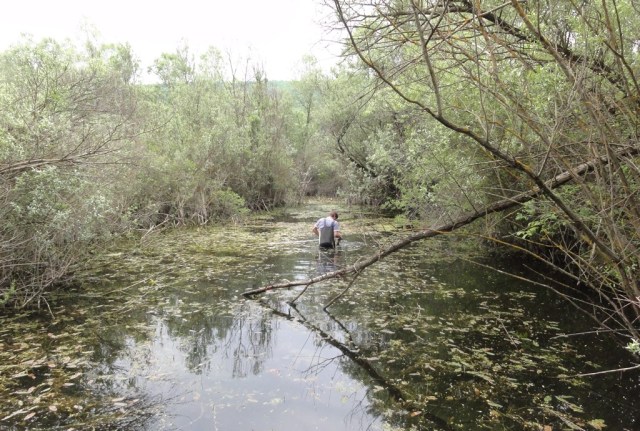
During a 2010 fieldtrip in Serbia, Jelka Crnobrnja-Isailović first introduced us to a cool pond near Vlasi, situated in the hybrid zone between T. ivanbureschi and T. macedonicus. This pond is inhabited by a big crested newt population, with individuals showing a wide range of phenotypes, running from one species to the other, and everything in between. We know that the hybrids between T. ivanbureschi and T. macedonicus are fertile: the genomic footprint of hybrid zone movement left when T. macedonicus displaced T. ivanbureschi strongly supports backcrossing between the two. In a new paper published in PeerJ we genotype a lot of individuals from Vlasi to show that the two parental species truly blend into one another here. An analysis of population demography (based on skeletochronology) shows that the size and longevity of the Vlasi hybrids do not deviate from the two parental species, which is the case for the huge, old and practically infertile hybrids between marbled and crested newts in France. Hence, we find support for the hypothesis that, at least in Triturus, fertile hybrids allocate resources to reproduction and infertile hybrids allocate resources to growth.
Reference: Arntzen, J.W., Üzüm, N., Ajduković, M., Ivanović, A., Wielstra, B. (2018). Absence of heterosis in hybrid crested newts (Triturus ivanbureschi x T. macedonicus). PeerJ 6: e5317.



 Wielstra Lab