
Balanced lethal systems pose an evolutionary paradox: they should not evolve because they cut reproductive output in half, yet they have done so time and again. The aim of my ERC Starting Grant project is to solve this evolutionary mystery. I give a bit of background on balanced lethal systems, summarize the main hypotheses on their origin, and outline how a combination of genomics and evolutionary modelling may provide the key to finally understanding them, in a new ‘quick guide’ published in Current Biology.
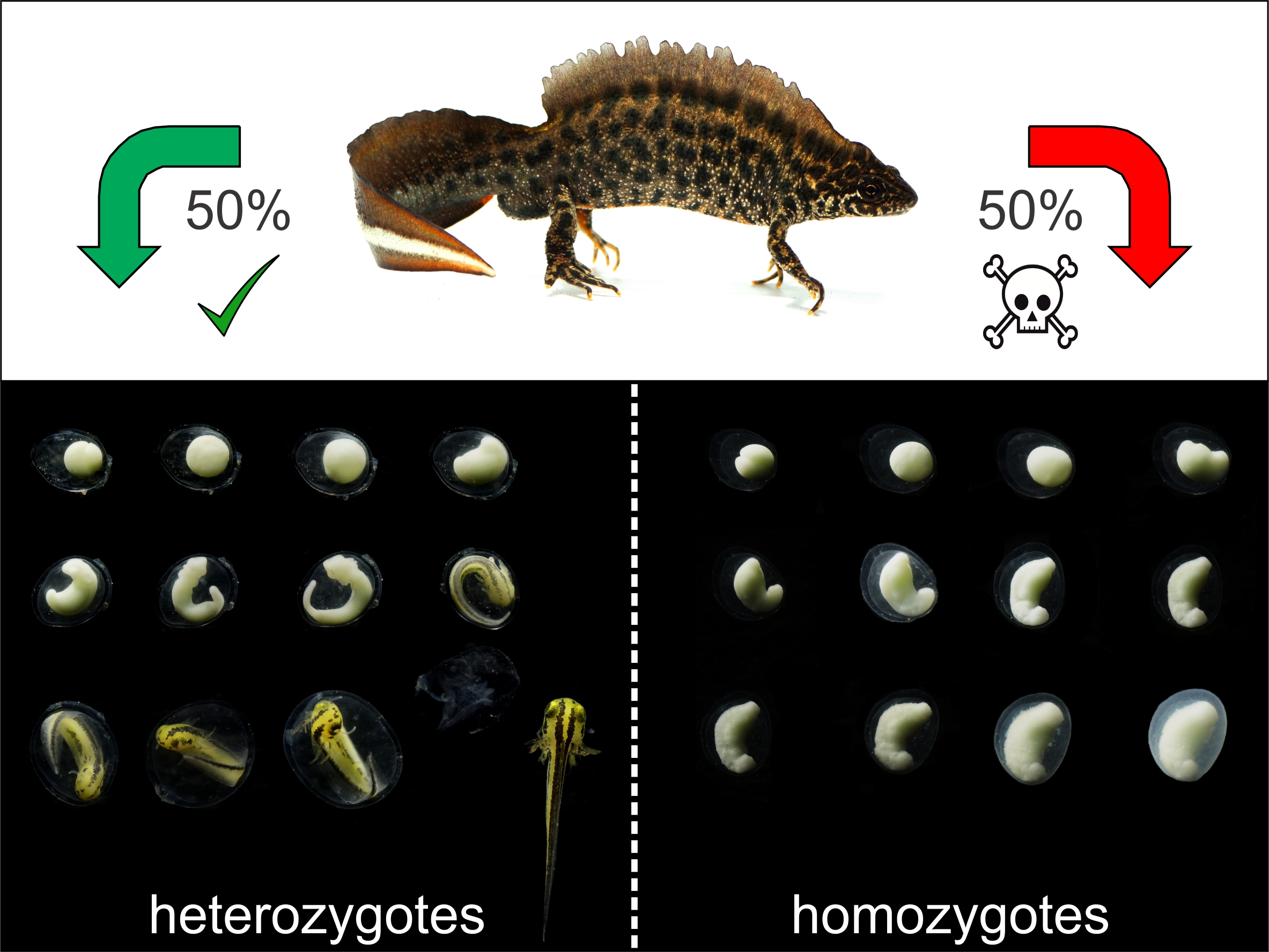
The balanced lethal system in Triturus, known as chromosome 1 syndrome, in action. Heterozygous offspring experience normal embryonic development, while homozygous offspring experience developmental arrest and die, halfway through normal embryogenesis. Hence, chromosome 1 syndrome is responsible for half of eggs laid never hatching. (Thanks to Michael Fahrbach for use of his pictures.)
Reference: Wielstra, B. (2020). Balanced lethal systems. Current Biology 30(13): R742-R743.

This project has received funding from the European Research Council (ERC) under the European Union’s Horizon 2020 research and innovation programme (Grant Agreement No. 802759).


 Wielstra Lab
Why is having one copy of this gene so important?
We don’t know which are the genes that are crucial for survival in the balanced lethal system yet. But the existence of some genes that are crucial for survival is a reasonable assumption. As half a chromosome is involved there should be MANY candidates.
Pingback: One way to evolve a balanced lethal system | Wielstra Lab