
Loïs Rancilhac heads a nice salamander study that is just out in Molecular Phylogenetics and Evolution. Lots of collaborators contributed a ton of genetic data for almost all the genera that make up Salamandridae – the salamander family that includes our beloved newts. This vast dataset allowed Loïs to recover a highly supported phylogenetic tree, with some cool improvements over previous attempts. I just love that the flamboyant banded and alpine newts are each other’s closest relatives, they truly are a perfect match! However, for me the most important insight is that the smooth newts and the crested/marbled newts are recovered as sister lineages. The new Salamandridae tree will allow my lab to conduct more targeted comparative genomics in our quest to infer the evolution of the balanced lethal system in Triturus.
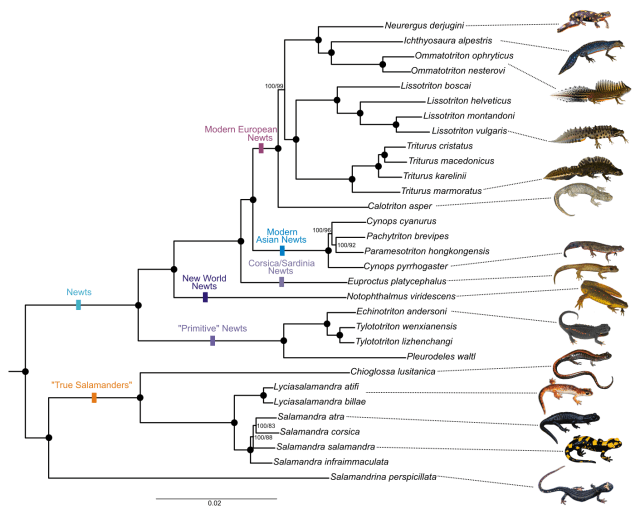 Reference: Rancilhac, L., Irisarri, I., Angelini, C., Arntzen, J.W., Babik, W., Bossuyt, F., M., Künzel, S., Lüddecke, T., Pasmans, F., Sanchez, E., Weisrock, D., Veith, M., Wielstra, B., Steinfartz, S., Hofreiter, M., Philippe, H., Vences, M. (2021). Phylotranscriptomic evidence for pervasive ancient hybridization among Old World salamanders. Molecular Phylogenetics and Evolution 155: 106967.
A solid salamander tree

This entry was posted in Uncategorized. Bookmark the permalink.

 Wielstra Lab
Pingback: One way to evolve a balanced lethal system | Wielstra Lab
Pingback: No support for a link between the balanced lethal system and ancient sex chromosomes | Wielstra Lab