
The ranges of crested newts were heavily affected by the cold-warm cycles of the Pleistocene ice age. The Italian crested newt (Triturus carnifex) is particularly interesting in this regards: it occurs in both the Balkan and Italian Peninsulas: two of the main ‘glacial refugia’ of Europe, where species managed to survive the glacial cycles (cold spells) and from which recolonization of temperate Europe was possible during interglacial cycles (warm spells). The Balkan and Italian T. carnifex populations were already known to be genetically quite distinct in their mitochondrial DNA (but that is just a single gene) and based on many markers obtained with my sequence capture protocol (but that included just a few samples).
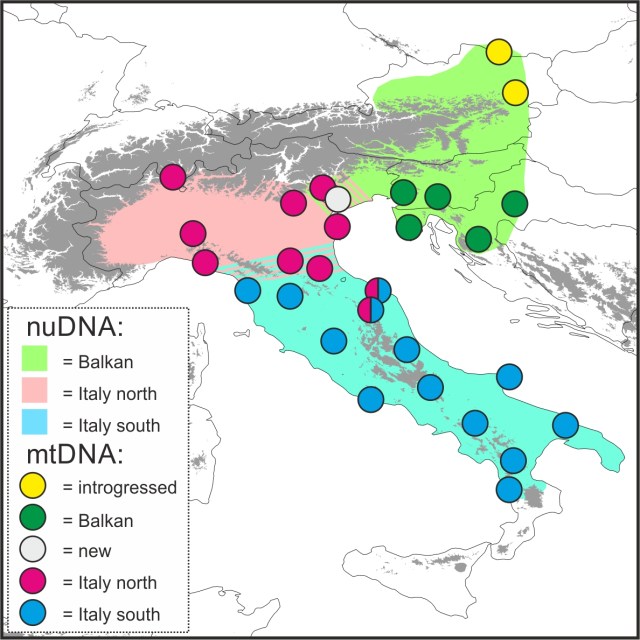
Using a thorough sampling and my Ion Torrent protocol, we show in a new paper that the Balkan and Italian populations meet at a narrow hybrid zone in northeast Italy, suggesting that they truly have become quite distinct as they were recurrently isolated during glacials. We also confirm deep genetic divergence within the Italian Peninsula, in line with a refugia-within-refugia scenario. An earlier mitochondrial DNA study was pretty much on the mark in terms of the inferred evolutionary history of the Italian crested newt, but our new nuclear DNA results do provide a clearer picture. We show that a quite distinct mtDNA lineage occurs right in the middle of the Balkan-Italian hybrid zone. We hypothesize this might be a ‘ghost lineage’ (a distinct mitochondrial DNA lineage that does not correspond to a noticeable nuclear DNA group) that managed to survive in a local newt population that was repeatedly genetically swamped when the Balkan and Italian populations regained secondary contact. Also, we show that mitochondrial DNA from the northern Italian population has introgressed (flowed) into the southern one. We attribute this to population replacement with hybridization, with south outcompeting north.
Reference: Wielstra, B., Salvi, D., Canestrelli, D. (2021). Genetic divergence across glacial refugia despite interglacial gene flow in a crested newt. Evolutionary Biology 48(1): 17-26.


 Wielstra Lab