

Male T. karelinii. Picture by Michael Fahrbach.
The southern crested newt (Triturus karelinii) has a striking distribution pattern. It is endemic to the Pontocaspian region and its range comprises three disconnected sections: a Crimean, a Caucasian and a Caspian one. A previous mtDNA phylogeographical survey suggested that the Caucasian range section was colonized from the Caspian one and that the Crimean range section was subsequently colonized from the Caucasian one.
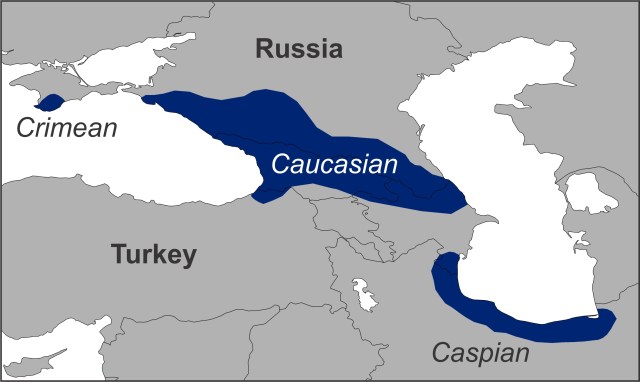
The three disjunct range sections of Triturus karelinii.
In a paper published in Amphibia-Reptilia we look into this proposed colonization history in a bit more detail. Nuclear DNA shows little genetic differentiation between the three range sections and species distribution modelling suggests that they only recently became isolated. While the Crimean range section was indeed only recently colonized, the Caspian and Caucasian ones have been inhabited long-term. Our findings support extensive gene flow between the currently isolated range sections and little genetic diversity across the southern crested newt range.
Reference: Wielstra, B., Arntzen, J.W. (2021). Genetic homogeneity in a Pontocaspian crested newt suggests recent isolation of its three allopatric range sections. Amphibia-Reptilia 42(2) 179-187.


 Wielstra Lab