
In the 1970s Jozef F. Schmidtler noticed that crested newts in the Berchtesgadener Land, in the extreme southeast of Germany, show morphological characteristics of the Italian crested newt (Triturus carnifex). A particular striking feature was the bright yellow stripe along the back of some juveniles. While this stripe is typical for the Italian crested newt, it is not usually found in the crested newt species that is widely distributed throughout Germany: the northern crested newt (T. cristatus). Schmidtler published his findings in the journal Salamandra.
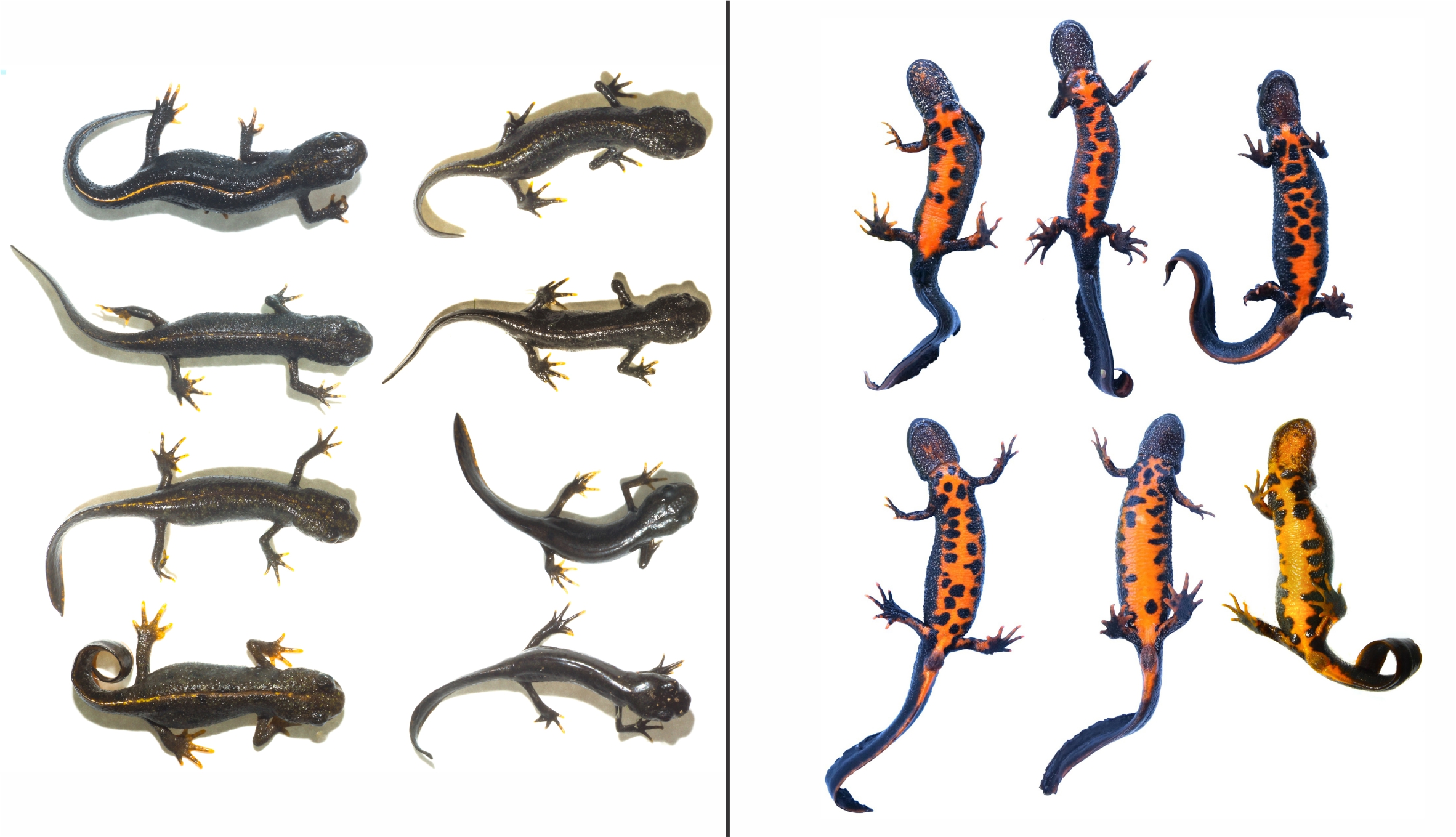
In a new paper also published in Salamandra we employ a genetic toolkit that was originally designed to screen for ‘genetic pollution’ from the Italian into the northern crested newt. For some reason the Italian crested newt has repeatedly been introduced inside the range of the northern crested newt. Hybridization between the two species poses a complicated conservation concern. The genetic toolkit should be able to pick up ‘Italian alleles’ in the natural hybrid zone just as well. Our results are obvious: alleles of the Italian crested newt are indeed present in the Berchtesgadener Land. In other words, the natural hybrid zone between the northern and Italian crested newts just reaches Germany.

Reference: Fahrbach, M., de Visser, M., Wielstra, B. (2021). The hybrid zone between the Italian and Northern crested newts (Triturus carnifex and T. cristatus) reaches Germany. Salamandra 57(1): 428-434.


 Wielstra Lab