Genetic pollution, gene flow from invasive to native species species, poses a complicated conservation question. It is well-known in crested newts. Why should we care about genetic pollution? To put it bluntly, genetic pollution equals extinction. In a ‘scientists’ warning’ paper published in Discover Conservation, led by my PhD student Anagnostis Theodoropoulos, we introduce genetic pollution and stress that it is an insidious but pervasive problem. While we now have the tools available to clean up genetic pollution, policy on the problem is seriously lacking. We hope our paper serves as a call to action.
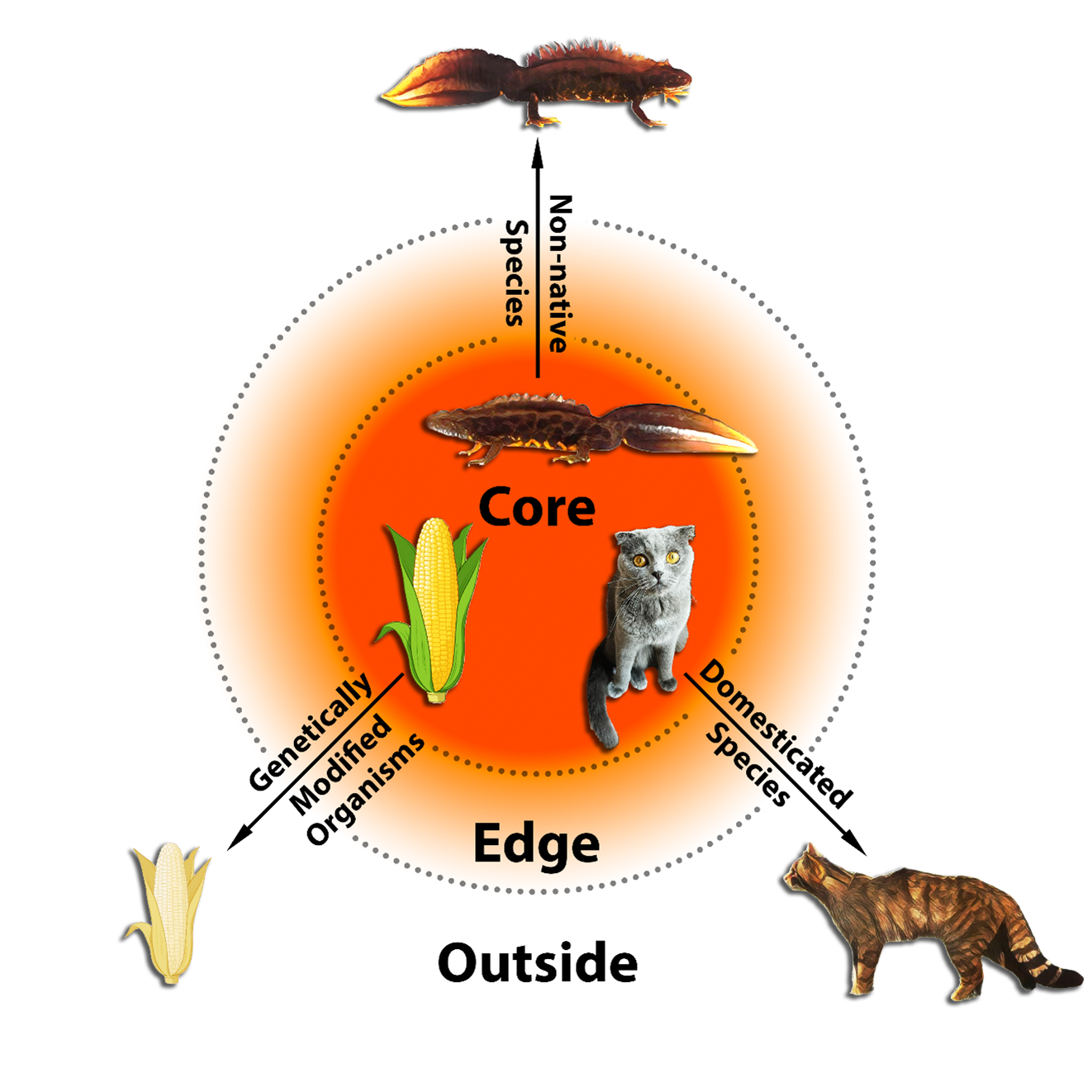
Genetic pollution at work: the orange color indicates the region dominated by non-native genetic material, whereas the white area signifies the gene pool of a native species. The gradient in between reflects non-native genes seeping into the native species.
Reference: Theodoropoulos, A., Stewart, K.A., Wielstra, B. (2025). Scientists’ warning on genetic pollution. Discover Conservation 2: 20.
This project has received funding from the Dutch Ministry of Education, Culture and Science (incentive grant), the Dutch Research Council (NWO Vidi grant VI.Vidi.213.088) and the European Union’s Horizon 2020 research and innovation programme (Marie Skłodowska-Curie grant agreement No. 655487).
I am a biologist interested in the interaction among closely species, both ecologically and genetically, during the course of their evolution. In my studies I'm employing the newt genus Triturus.




 Wielstra Lab