Two ways to genetically determine if a newt embryo is doomed to die by balanced lethal system

In the balanced lethal system in Triturus newts, individuals that inherit either the 1A or the 1B version of chromosome 1 twice will experience developmental arrest and die halfway embryonic development. Before that time, it has been impossible to predict which embryos are viable and which are doomed to die – until now. My PhD students Willem Meilink and Manon de Visser lead a paper, out in Ecology and Evolution, in which they use our genomic insights into the balanced lethal system (stay tuned!) to devise two distinct approaches to determine if an individual only possesses 1A (diseased), only possesses 1B (also diseased), or posses both 1A and 1B (healthy). This is very helpful in the balanced lethal system research program!
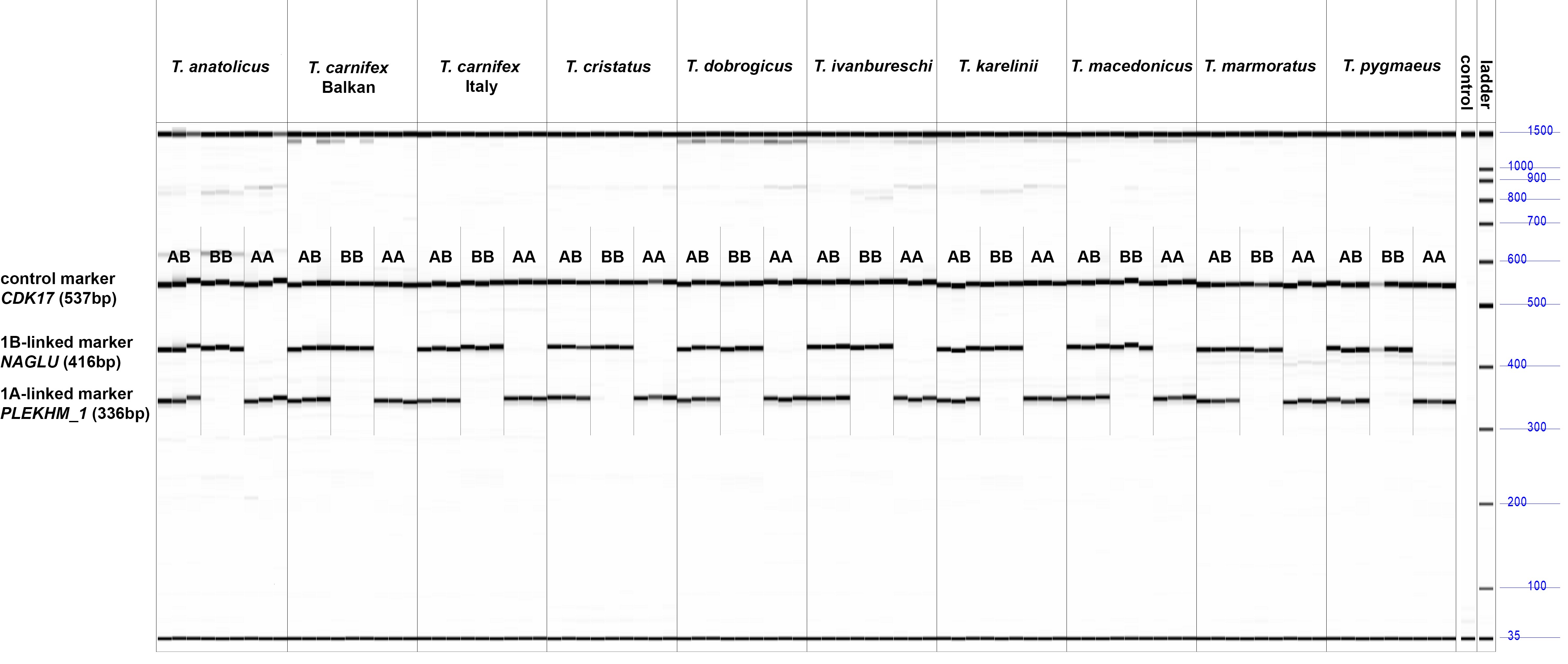
Individuals that possess 1A twice (and therefore not 1B) show a band for a 1A-linked but not a 1B-linked marker after gel elecrophoresis and vice versa. Individuals that possess and 1A and 1B display both of these bands.

Reference: Meilink, W.R.M., de Visser, M.C., Theodoropoulos, A., Fahrbach, M., Wielstra, B. (2025). Determining zygosity with multiplex Kompetitive Allele-Specific PCR (mxKASP) genotyping. Ecology and Evolution 15(6): e71642.

This image has an empty alt attribute; its file name is logo-erc-nwo.jpg
The PhD position of WRMM is supported by the Nederlandse organisatie voor Wetenschappelijk Onderzoek (NWO Promotiebeurs voor leraren 023.016.006). This project has received funding from the European Research Council (ERC) under the European Union’s Horizon 2020 research and innovation programme (Grant Agreement No. 802759).

Unknown's avatar

About Ben Wielstra

I am a biologist interested in the interaction among closely species, both ecologically and genetically, during the course of their evolution. In my studies I'm employing the newt genus Triturus.
This entry was posted in Uncategorized. Bookmark the permalink.

Leave a comment