
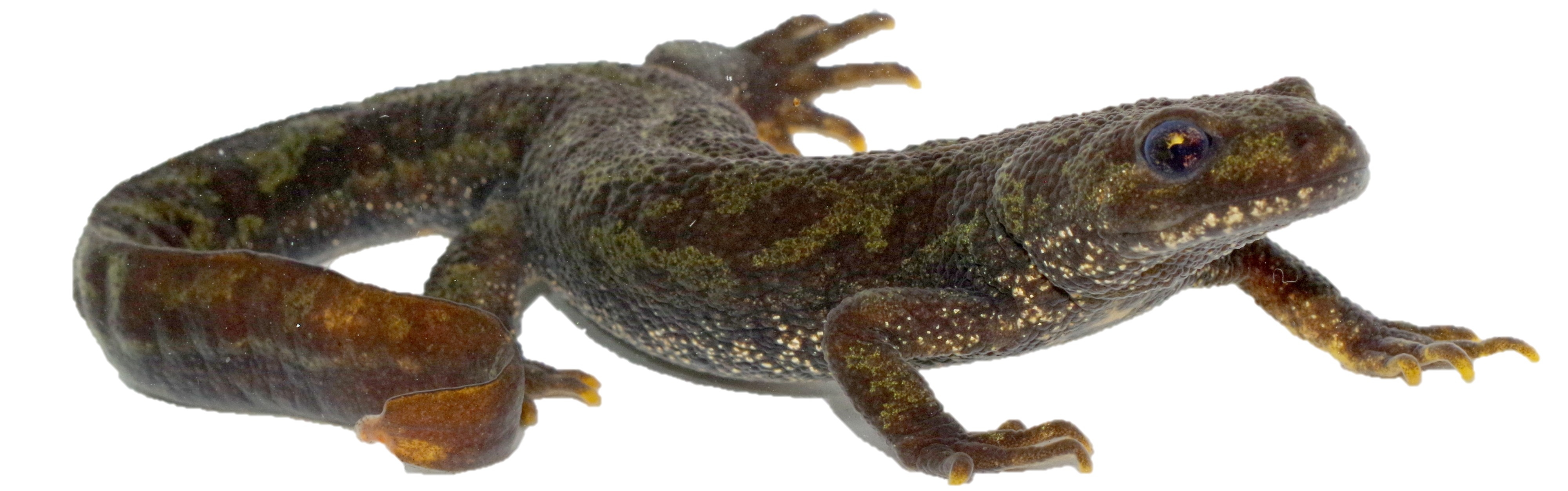
Most animals are diploid, meaning they have two copies of each chromosome. One of these copies they inherited from their mother and the other one from their father. Sometimes the number of chromosome copies differs. In a new paper out in Journal of Heredity we explore the occurrence of triploidy, where individuals have three instead of two copies of a chromosome, in the hybrid zone between crested and marbled newts. In a large set of hybrids, we find quite some newts that appear to have twice as many alleles (gene versions) of one of the parent species. We test two of these individuals with different techniques and independently confirm that they truly are triploids. Thus, triploidy is not that rare in Triturus.
Reference: Arntzen, J.W., McCartney-Melstad, E., Litvinchuk, S., Wielstra, B. (2026). Triploidy in a pair of hybridizing salamanders at the far end of the speciation continuum. Journal of Heredity TBA.
This project has received funding from the European Research Council (ERC) under the European Union’s Horizon 2020 research and innovation program (Grant Agreement No. 802759).


 Wielstra Lab