

The crested newt traditionally referred to as ‘Triturus karelinii‘ has been split into three species. This map shows their approximate ranges and type localities.
The crested newt species traditionally referred to as ‘Triturus karelinii’ has turned out to be a group of cryptic species. A range-wide mtDNA phylogeography revealed that this taxon comprises three mtDNA clades, as distinct from one another as recognized crested newt species are. To assess the biological meaning of the mtDNA results we subsequently analysed three nuclear DNA markers. The resulting dataset confirmed the existence of three distinct nuclear DNA groups: an eastern, a central and a western one.
There is no evidence for gene flow between the allopatric eastern group and the other two and, based on the type locality, we restricted the name T. karelinii sensu stricto to the eastern group. For the western plus central group the name ‘T. arntzeni’ has previously been used, but at its type locality only newts that show genetic admixture between (predominantly) T. macedonicus and the western group occur. Hence we proposed an alternative name, T. ivanbureschi (sensu lato), in which we placed both the western and central group for the time being.
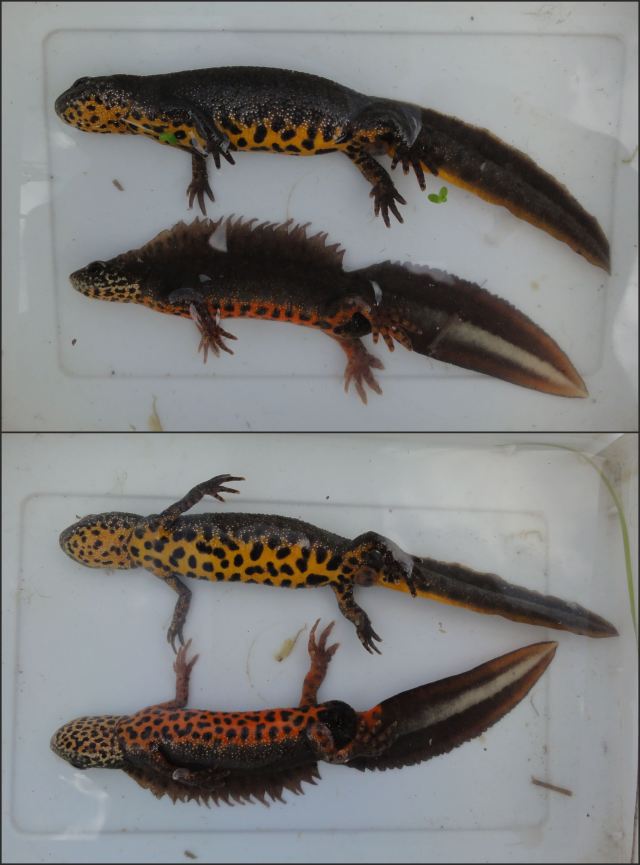
These sedated newts, a female above and a male below, are from the type locality of Triturus anatolicus.
The taxonomical question of whether the two groups comprising T. ivanbureschi sensu lato are different species remained. As the two occur in parapatry and show evidence of at least some recent gene flow, we preferred not to jump to conclusions. We first conducted a detailed hybrid zone analysis with the aid of the Triturus Ion Torrent protocol. Although not the main aim of the hybrid zone study (to be published separately) we could use the data to determine if the two groups comprising T. ivanbureschi should be regarded as distinct species. We could confirm that both groups comprising T. ivanbureschi sensu lato manage to maintain their genetic integrity. Because the type locality is positioned in the range of the western group, the name of T. ivanbureschi should be restricted to that group. We have now described the central group as a distinct species, dubbed T. anatolicus, in the journal Zootaxa. Up to now only genetic data have been used to identify the three crested newt species comprising the T. karelinii sensu lato group. The next step is to take a better look at these newts and see if morphological features that separate the species can be discovered.
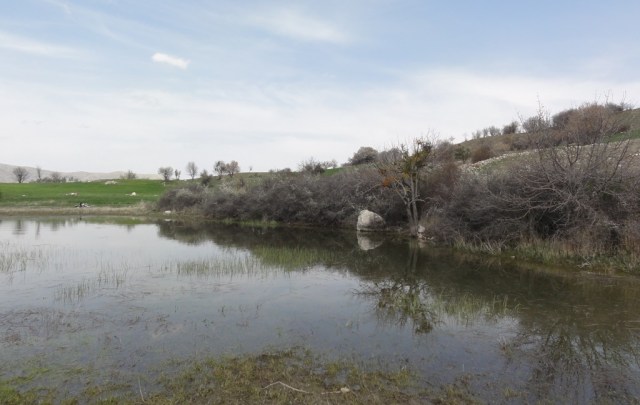
This pond is the type locality of Triturus anatolicus.
Reference: Wielstra, B., Arntzen, J.W. (2016). Description of a new species of crested newt, previously subsumed in Triturus ivanbureschi (Amphibia: Caudata: Salamandridae). Zootaxa 4109(1): 073-080.



Pingback: A genomic footprint of hybrid zone movement in crested newts | Ben Wielstra