

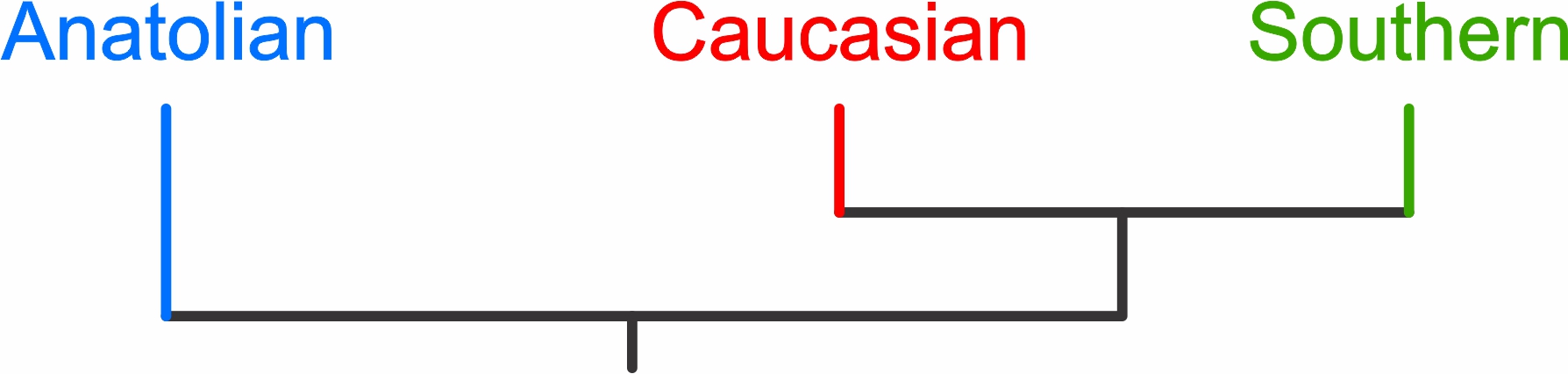
The awesome banded newt genus comprises three cryptic species that are really old and have little to no genetic exchange between them. However, the ancestral banded newt appears to have radiated into three species in a relatively short time span. Under such conditions, it is notoriously difficult to retrace the order in which species split. We certainly tried before – and failed. But now, in a paper led by my former MSc students Konstantinos Kalaentzis and Stephanie Koster and out in Molecular Phylogenetics and Evolution, we finally manage to resolve the banded newt phylogeny. The Anatolian banded newt, (currently) in contact with the Caucasian banded newt, is the first offshoot, whereas the Caucasian banded newt is the sister species of the (at the moment) geographically isolated Southern banded newt. Resolving the banded newt phylogeny was only possible because of the Triturus sequence capture protocol, which allows us to get genome-scale data for any newt!
Reference: Kalaentzis, K., Koster, S., Arntzen, J.W., Bogaerts, S., France, J., Franzen, M., Kazilas, C., Litvinchuk, S.N., Olgun, K., de Visser, M.C., Wielstra, B. (2025). Phylogenomics resolves the puzzling phylogeny of banded newts (genus Ommatotriton). Molecular Phylogenetics and Evolution 203: 108237.


 Wielstra Lab