DNA can teach us all kinds or things, but you do need to collect it first, before you are able to read it out. If you study for example hybridization between two species, you need to sample many individuals, from many populations. However, in principle you can also get a population-level sample from environmental DNA – the DNA that the members of a population shed in the environment. PhD student Daniel Zumel Gete shows proof of concept in a paper in Molecular Ecology Resources.
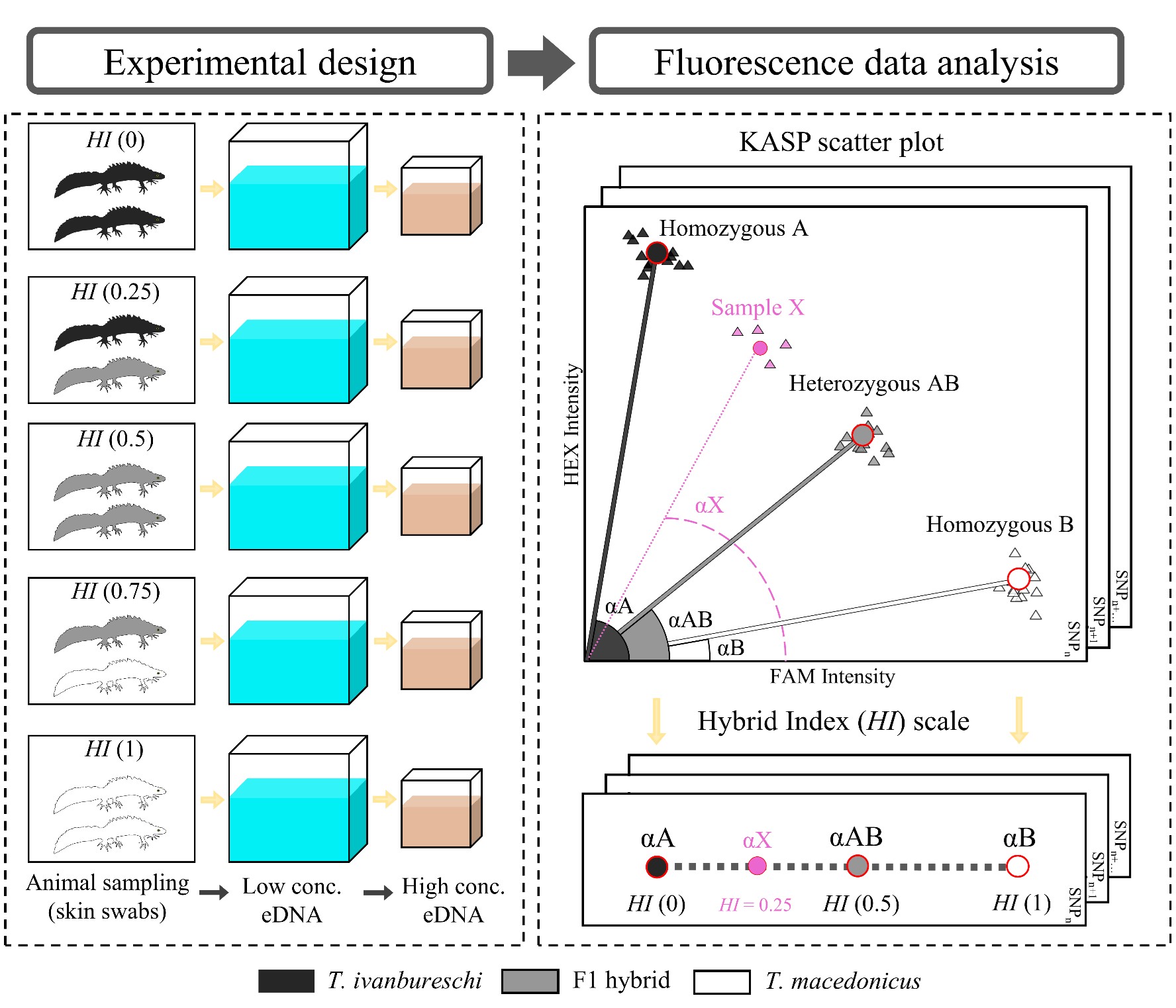
At the crested newt colony in Belgrade, Serbia, we mimicked a hybrid zone. We put individuals of different species, as well as hybrids between them, together in tanks, in different combinations. The artificial populations ran from genetically purely the one species, via different degrees of genetic admixture, to genetically purely the other species. Dani shows a strong correlation between the DNA profile of the actual newts placed together and the DNA profile obtained from water samples in the tanks. The next step is to test this in the field.
Reference: Zumel, D., Didaskalou, E., Vučić, T., Cvijanović, M., Ivanović, A., Ajduković, M., Wielstra, B., Theodoropoulos, A., Stewart, K. (2026). Hybrid horizons: Screening hybridization through nuclear environmental DNA. Molecular Ecology Resources 26(4): e70134.