Cryptic crested newt species

The crested newt traditionally referred to as ‘Triturus karelinii’ comprises three distinct mitochondrial DNA clades. These clades are found in the east, the centre and the west of the range. The difference between mitochondrial DNA clades is comparable to the difference between the mitochondrial DNA of recognized crested newt species. We wanted to see if the three mitochondrial DNA clades might in fact represent different species.

BAPSThis plot shows individuals (thin bars) within populations (thick bars) roughly ordered from west to east. Based on their genotype, individuals are allocated (0-100%) to three geographical genetic groups (represented by different colors).
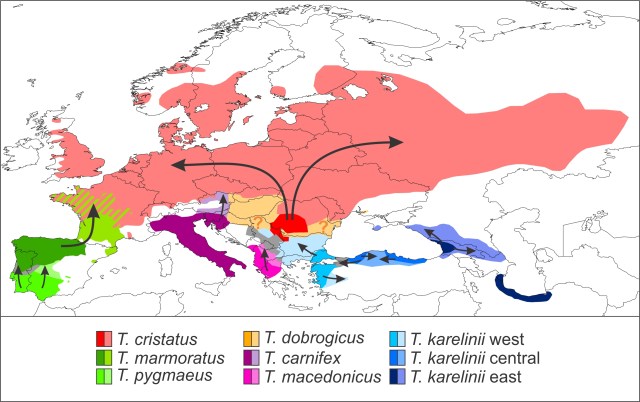
In a paper published in Molecular Phylogenetics and Evolution we show that, based on three nuclear genes, there are three discrete geographical groups, in line with the three species hypothesis. We suggest that these three groups should be considered distinct species, but as it is as yet unclear if they can be distinguished based on morphology, we refer to them as ‘cryptic species’ for now.

mapmpe13Here you see the three cryptic species that make up the T. karelinii-group of crested newts. An intriguing finding is that asymmetric DNA introgression from the western group into the central group (the red-green hatched area). We suggest that this pattern can be explained by the central group having expanded its range at the expense of the western group, while the two hybridized in the process. An interesting hypothesis to test in a future study!
Reference: Wielstra, B., Baird, A.B., Arntzen, J.W. (2013). A multimarker phylogeography of crested newts (Triturus cristatus superspecies) reveals cryptic species. Molecular Phylogenetics and Evolution 67(1): 167-175.

Posted in Uncategorized | 4 Comments

Mitochondrial DNA capture in smooth newts

Hybridizing species sometimes exchange genes in nature (a phenomenon called introgression). Introgression has particularly been documented for mitochondrial DNA. This might mean mitochondrial DNA is more susceptible to introgression, but it is also the case that researchers have simply studied mitochondrial DNA more. Usually introgression is restricted to close to the hybrid zone. There are however more pronounced examples. It does not get more extreme than in smooth newts, where the original mitochondrial DNA of Lissotriton montandoni has been completely replaced by that of L. vulgaris.

smooth carpathian

A male Lissotriton montandoni on the left and a male L. vulgaris on the right. Pictures by team Babik.

In a paper published in Molecular Ecology we extensively sample both mitochondrial and nuclear DNA for L. montandoni and surrounding L. vulgaris populations. We also use species distribution modelling to determine range dynamics of L. montandoni since the Last Glacial Maximum. We show that mitochondrial DNA introgression occurred several times, and at different moments, in different parts of the range of L. montandoni. This is probably related to the inferred range fragmentation under glacial conditions, and  independent range expansion from these range fragments into L. vulgaris territory when the climate ameliorated. In contrast, there is little evidence of recent nuclear gene flow between the species.

mtDNA capture

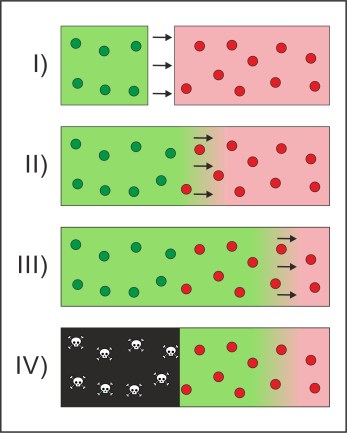
A visualization of complete mitochondrial DNA capture in response to species displacement and range reduction. We are dealing with two species here, let’s call them green and red. These species possess distinct mitochondrial DNA. Panels are ordered chronologically. In the panels, dots reflect localities, while boxes represent rough outlines of the ranges. Background shading (green or red) reflects species identity, while localities are colored according to the mitochondrial DNA type present (so dots are green or red).
In I) the ranges of the two species are geographically separated. At this stage, green mitochondrial DNA is only found in localities of the green species, and red mitochondrial DNA in localities of the red species. However, the green species is doing well for itself and, over the generations, its population increases. Surplus individuals from the right edge of the range start colonizing new localities further right. In these localities, numbers start increasing again and some offspring colonize new localities even further right, and so on. With time, the green species expands its range to the right, towards that of the red one.
In II) the ranges of the two species have come into contact. Where they meet, the two species start reproducing with one another (hybridization), resulting in offspring that are a mix of both green and red. Initially there are relatively few green individuals, but they keep pouring into the into the hybrid zone, while this is not the case for red individuals. Hybrids already present mate with these green individuals, and their offspring again mate with green individuals, and so on. Over time, individuals in the hybrid zone become ‘greener’. However, because at the initial stage of invasion by the green species most matings will concern individuals that also have red genes, some of these red genes rather than their green counterparts could locally get fixed in (introgress into) the green species by chance (and several processes that we won’t go into now might reinforce introgression). In this case mitochondrial DNA introgresses. Hence, at the right edge of the green species range, you start to see localities where individuals belong to the green species, but possess mitochondrial DNA typical of the red species (red dots in a green range).
In III) the individuals in the initial hybrid zone have become all green, except their mitochondrial DNA. Still the green species keeps expanding its range further to the right. Once again green individuals meet red ones, start hybridizing and gradually take over, and so on. In consequence, the hybrid zone between the two species moves towards the right, as the green species replaces the red species. Yet, the members of the green species at the frontier, as well as the red individuals they hybridize with, only possess red mitochondrial DNA. So the region to the right of the initial hybrid zone becomes ‘greener’, but the overturn between green and red mitochondrial DNA still aligns with that initial hybrid zone. One way to put this is that the red mitochondrial DNA ‘surfs the wave’ of the green species expansion. In effect you end up with red localities on a green background over a considerable area.
In IV) the hybrid zone between the green and the red species has stabilized at a region where the green species does not have an edge over the red species as it did before. At the same time the part of the green species’ range where it still possessed the green mitochondrial DNA type becomes unsuitable and here the green species goes extinct (black background). As a result, there are now only members of the green species left that possess red mitochondrial DNA, while the original green mitochondrial DNA has been lost.

Reference: Zieliński, P., Nadachowska-Brzyska, K., Wielstra, B., Szkotak, R., Covaciu-Marcov, S., Cogălniceanu, D., Babik, W. (2013). No evidence for nuclear introgression despite complete mtDNA replacement in the Carpathian newt (Lissotriton montandoni). Molecular Ecology 22(7): 1884-1903.

Posted in Uncategorized | Leave a comment

Crested newt skulls

The Triturus karelinii-group of crested newts comprises three mitochondrial DNA lineages, but no morphological differences are known. In a paper published in Zoologischer Anzeiger we analyse skull shape to see if there are differences between lineages. While we do not find three discrete geographical groups, the observed differences among lineages are also not smaller than between lineages and another crested newt species, T. macedonicus. We just need to keep looking for morphological differences.

Reference: Ivanović, A., Üzüm, N., Wielstra, B., Olgun, K., Litvinchuk, S.N., Kalezić, M.L., Arntzen, J.W. (2013) Is mitochondrial DNA divergence of Near Eastern crested newts (Triturus karelinii group) reflected by differentiation of skull shape? Zoologischer Anzeiger 252(2): 269-277.

Posted in Uncategorized | Leave a comment

Tracing glacial refugia of crested newts

The Quaternary Ice Age heavily influenced the distribution of species. During the colder glacial periods, species went extinct in part of their range, while during warmer interglacial periods, they could recolonize these regions again. This contraction-expansion pattern left its mark on genetic diversity across species’ ranges, with high diversity in regions where species survived continuously, and low diversity in regions where they were periodically wiped out. Past range shifts can also be visualized by projecting species distribution models, based on the environmental conditions currently experienced, on climate reconstructions of the past.

In a study published in Frontiers in Zoology we explore how all the marbled and crested newts species (so the entire genus Triturus) responded to the climate change associated with the Ice Age. We conduct a phylogeographical survey, meaning we sequence a lot of mitochondrial DNA, for many populations throughout each of the species ranges, and look at variation in genetic diversity across species ranges. Additionally, we compare species distribution models projected on current and on past climate layers (the Last Glacial Maximum, about 21,000 years ago).

Fzoolscenario

A visualization of the biogeographical scenario proposed, showing the positions of glacial refugia in dark shades and the regions postglacially colonized in light shades for each individual species. In grey areas we infer that one species displaced another as they shifted their ranges.

By combining the two independent techniques of phylogeography and species distribution modelling, we obtain a more complete understanding of the historical biogeography of the crested and marbled newts than both approaches would have provided on their own.

Reference: Wielstra, B., Crnobrnja-Isailović, J., Litvinchuk, S.N., Reijnen, B., Skidmore, A.K., Sotiropoulos, K., Toxopeus, A.G., Tzankov, N., Vukov, T., Arntzen, J.W. (2013). Tracing glacial refugia of Triturus newts based on mitochondrial DNA phylogeography and species distribution modeling. Frontiers in Zoology 10: 13.

Posted in Uncategorized | 2 Comments

PhD thesis defended

image description

On 3 October 2012 I defended my PhD thesis, which can be found here.

Posted in Uncategorized | Leave a comment

Species displacement in crested newts

A regular observation around the zones where closely related species meet, mate and produce offspring (hybrid zones) is that mitochondrial DNA of one of the species extents into part of the range of the other species (asymmetric mitochondrial DNA introgression). The classic explanation for this pattern is that positive selection has pulled foreign mitochondrial DNA into a species’ range, because it has some kind of advantage over native mitochondrial DNA. An alternative explanation is that the hybrid zone between the two species has moved, while the mitochondrial DNA of the receding species was left behind in the invading one.

12BMCmtintrThis figure shows how mitochondrial DNA can be transferred across the species boundary via introgressive hybridization. Large circles reflect the nuclear DNA composition of individuals and small ones their mitochondrial DNA type. There is an initial hybridization event between the members of two species, a red female and a green male. The F1 offspring contain a mix of red and green nuclear DNA, as this is inherited from both parents, but only red mitochondrial DNA, because mitochondrial DNA is only transmitted via the mother. Over subsequent generations, admixed females mate (backcross) with green males. In time the red nuclear DNA dilutes out and in effect we end up with a species that, from the nuclear DNA perspective, is completely green, but that possesses red mitochondrial DNA.

How can you distinguish between two processes that would basically result in the same pattern? A key difference is that according to the first explanation the hybrid zone is stable, while according to the second explanation the hybrid zone moves. Therefore, independent insight into hybrid zone mobility could help figure out what caused asymmetric mitochondrial DNA introgression.

12BMC2scenarioThis figure shows two scenarios that could result in geographically asymmetric mitochondrial DNA introgression. We have a green and a red species. The background reflects nuclear DNA composition in space. Circles reflect the spatial distribution of mitochondrial DNA. The black bar represents the hybrid zone between the two species and the grey boundary the geographical overturn between the two mitochondrial DNA types. In both panels mitochondrial DNA of the red species has introgressed into the green one when they started hybridizing. In the top panel the green species subsequently outcompetes the red one and the species boundary moves towards the left. The green individuals at the frontier possess red mitochondrial DNA, and so does their offspring that gradually replaces the red species. Therefore,  red but not green mitochondrial DNA is spread into the region of species replacement via the green species (where red mitochondrial DNA is already present in the red species). Hence, the location of the geographical overturn between the two mitochondrial DNA types remains the same. In the bottom panel the location of the hybrid zone between the green and the red species is stable. However, the red mitochondrial DNA is beneficial to the green species and natural selection pulls it further and further into the green range over time. In effect, the geographical overturn between the two mitochondrial DNA types moves towards the left.
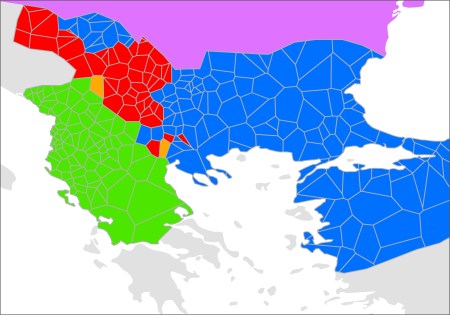
In a paper published in BMC Evolutionary Biology we look at a crested newt case of extensive mitochondrial DNA introgression on the Balkan Peninsula. We first delimit a ca. 54,000 km² area in which T. macedonicus contains T. ivanbureschi mitochondrial DNA. This introgression zone bisects the range of T. ivanbureschi, isolating an enclave from the main range. This enclave suggests hybrid zone movement as the cause of the observed asymmetric mitochondrial DNA introgression: it is unlikely that T. ivanbureschi managed to move across a large region inhabited by T. macedonicus (as newts cannot fly), while it is easy to imagine that T. macedonicus locally replaced T. ivanbureschi in the area between the enclave and the main range of T. ivanbureschi. Considering the high similarity of introgressed mitochondrial DNA haplotypes to those found in T. ivanbureschi today, introgression must be of recent origin.

12BMCintrzoneThis figure shows the geographical distribution of the two crested newt species and their mitochondrial DNA as Thiessen polygons (a.k.a. a Voronoi diagram). Each polygon covers the area that is closer to its corresponding crested newt locality than to another one. Green and blue polygons represent T. macedonicus and T. ivanbureschi localities with T. macedonicus and T. ivanbureschi mitochondrial DNA, respectively. The red polygons represent T. macedonicus localities with T. ivanbureschi mitochondrial DNA and the orange ones T. macedonicus localities where both T. macedonicus and T. ivanbureschi mitochondrial DNA are present. To delimit the introgression zone, we combined the orange and red polygons. The purple at the top reflects the area where other Triturus species are present, while the grey land (and white sea, obviously) is devoid of Triturus newts.
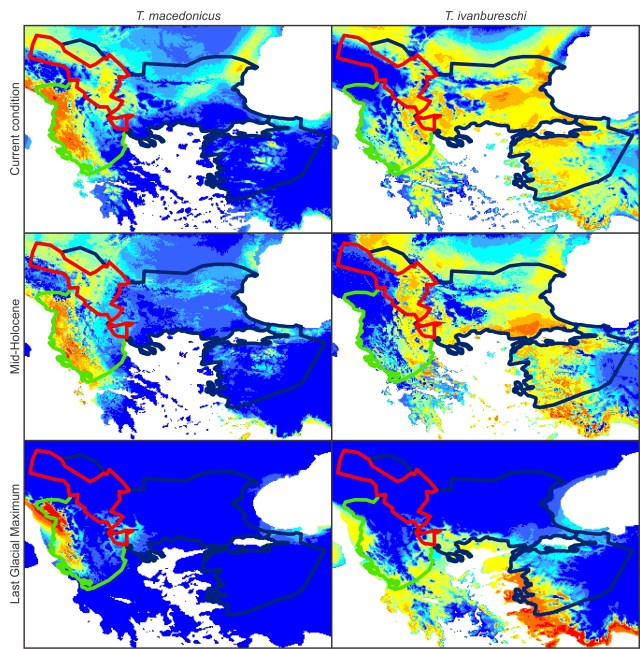
We make use of species distribution modelling (a.k.a. ecological niche modelling) to obtain insight into hybrid zone movement. In species distribution modelling you determine the ecological conditions at locations where you know a species is present and then you determine where else such conditions occur. Furthermore, if you have reconstructions of ecological conditions for past time periods, you can approximate past ranges. Most hybrid zones observed today were established after the last glaciation of the Quaternary Ice Age came to an end. Species that had their ranges reduced during glacial conditions expanded them again as the climate ameliorated and came into contact with other species that were doing the same. This makes the period since the end of the last glaciation particularly interesting to study with species distribution modelling. Fortunately, climate reconstructions for the Last Glacial Maximum (about 21,000 years ago) and the mid-Holocene (about 6,000 years ago) are available. We construct species distribution models for both crested newt species based on current climate data and project these on climate reconstructions of the two past time slices.

12BMCSDM.jpgThis figure shows species distribution models for T. macedonicus (left) and T. ivanburschi (right) projected on climate layers for the Last Glacial Maximum (bottom), Mid-Holocene (middle) and the present (top). The warmer the color, the more suitable the area. The blue line delineates the T. ivanbureschi range (with T. ivanbureschi mitochondrial DNA). The green line delineates the T. macedonicus range where its own mitochondrial DNA and the red line where this species carries introgressed T. ivanbureschi mitochondrial DNA. As you can see, the introgression zone was inhospitable for either species during the Last Glacial Maximum, suggesting that the pattern we observe today was established at a later stage. However, the zone would have been habitable again at the mid-Holocene. Since that time habitat suitability generally increased for T. macedonicus, while it decreased for T. ivanbureschi.
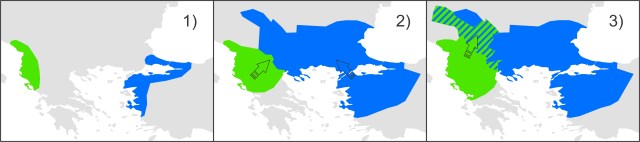
Taken the results of the mitochondrial DNA survey and the species distribution modelling together we can reconstruct a historical biogeographical scenario for this crested newt case. Based on the arrangement of the ranges of the two crested newt species involved (the enclave), and the insight provided by the mitochondrial DNA phylogeographic structure and species distribution models, we favor the hybrid zone movement rather than the positive selection hypothesis to explain the presence of T. ivanbureschi mitochondrial DNA in a big chunk of the range of T. macedonicus.

12BMCbiogeoscenarioThis figure shows a simplified historical biogeographical scenario to explain the observed mitochondrial DNA introgression between the two crested newt species. During the adverse climate conditions of the Last Glacial Maximum, the ranges of T. macedonicus (green) and T. ivanbureschi (blue) were restricted (1). When the climate improved, both species started to expand and obtained secondary contact (2). Subsequently, T. macedonicus invaded area occupied by T. ivanbureschi and locally took over, but as species displacement coincided with hybridization, T. ivanbureschi mitochondrial DNA was left behind in this part of the T. macedonicus range (3).
Reference: Wielstra, B., Arntzen, J.W. (2012). Postglacial species displacement in Triturus newts deduced from asymmetrically introgressed mitochondrial DNA and ecological niche models. BMC Evolutionary Biology 12: 161.

Note that the name T. karelinii is used throughout the paper. However, this former ‘species’ actually turned out to comprise three distinct species. This took some time and several papers to figure out, as explained in other blog posts. The species involved in the present case is now called T. ivanbureschi and I thought it was easier to stick to this new name in the present blog post.
Posted in Uncategorized | 2 Comments

Genetically distinct newts also show ecological divergence

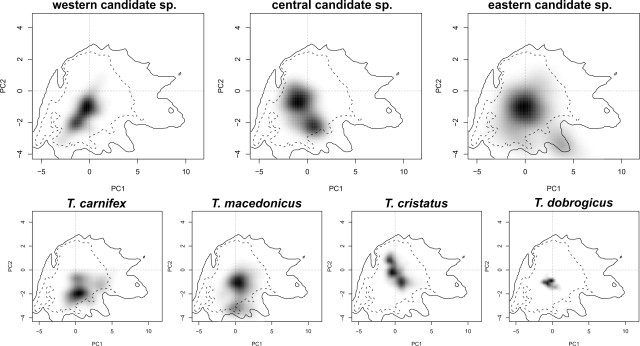
Geographical groups characterised by distinct mitochondrial DNA may still belong to a single species. However, if they are also ecologically distinct, this supports their species status. In a paper published in PLoS ONE we explore ecological differences among the three crested newt candidate species constituting the Triturus karelinii-group. We show that these differences are of a similar order as those observed between recognized crested newt species. Hence, from the perspective of both mitochondrial DNA and ecology, the candidate species are as diverged as ‘real’ species, in line with our hypothesis that they represent cryptic species.

PCA-envIn these squares you see a two dimensional representation of the niche space experienced by all crested newts together. The grey shading reflects the occurrence of each (candidate) species within that niche space.

Reference: Wielstra, B., Beukema, W., Arntzen, J.W., Skidmore, A.K., Toxopeus, A.G., Raes, N. (2012). Corresponding mitochondrial DNA and niche divergence for crested newt candidate species. PLoS ONE 7(9): e47771.

Posted in Uncategorized | Leave a comment

A highly supported crested newt phylogeny

Crested newts comprise four ‘morphotypes’: 1) the Triturus karelinii-group, 2) T. carnifex + T. macedonicus, 3) T. cristatus, and 4) T. dobrogicus. These four morphotypes range from sturdy to slender bodies. Body build is reflected by the number of rib-bearing pre-sacral vertebrae (NRBV), running from NRBV=13 (most sturdy) to NRBV=16 (most slender). Hence, NRBV approximates body build in crested newts. A final fun fact is that crested newt morphotypes differ ecologically. Body build is related to the duration of the annual aquatic period, which runs from three months for NRBV=13 to six months for NRBV=16. This suggest that ecology might have driven the crested newt radiation.

4morphotypes

Representatives of the four crested newt morphotypes, ordered from sturdy to slender: 1) T. anatolicus – NRBV=13 – aquatic 3 months; 2) T. macedonicus – NRBV=14 – aquatic 4 months; 3) T. cristatus – NRBV=15 – aquatic 5 months; 4) T. dobrogicus – NRBV=16 – aquatic 6 months. Pictures are by Michael Fahrbach.

To understand how this radiation of body shapes originated in crested newts, we should look at their evolutionary tree (their phylogeny). However, despite several previous attempts, employing a variety of molecular markers, phylogenetic relationships among crested newt morphotypes have never been resolved. For four morphotypes, 15 topologies are possible. The number of additions or subtractions of rib-bearing vertebrae during crested newt evolution differs between these topologies. So how flexible was NRBV during crested newt evolution?

15 tree topologies
All possible topologies for a phylogeny for four crested newt morphotypes. The four letter abbreviations refer to the morphotypes and the NRBV value for each is between parentheses. The upper left topology requires the least amount of evolutionary change to explain the radiation in NRBV observed today.

In a paper in BMC Evolutionary Biology we finally manage to obtain a well-supported, fully resolved crested newt phylogeny, by using complete mitochondrial genome sequences. We can now look at the evolution of the radiation in body build in crested newts, in the context of the new phylogeny. By taking a step back and looking at NRBV values in other salamanders, we can give NRBV evolution a direction. Most salamanders have a relatively low NRBV=13. Therefore, the root of the crested newt tree, furthest back in time, can be set at NRBV=13 as well. This means that the proto crested newt likely had a low NRBV value, like the T. karelinii-group today (which is also 13), while the higher NRBV values seen in crested newts probably evolved at a later stage.

fullmttree
The crested newt phylogeny based on complete mitochondrial genome sequences. The colours reflect the NRBV values of the four crested newt morphotypes. The changes in NRBV over the course of the evolution of the crested newts are noted along the branches of the tree.

A basal dichotomy separates the T. karelinii-group (NRBV=13) from the remaining crested newts. The next split divides T. carnifex + T. macedonicus (NRBV=14) versus the rest. Finally there is a divide between T. cristatus (NRBV=15) and T. dobrogicus (NRBV=16). To explain the evolution of NRBV, given the new phylogeny, three additions of a rib-bearing vertebrae are required. This actually is the minimal number of steps possible to explain the variation in NRBV observed today (in technical terms, the new phylogeny supports a maximally parsimonious interpretation of NRBV evolution). The new phylogeny makes sense!

Reference: Wielstra, B., Arntzen, J.W. (2011). Unraveling the rapid radiation of crested newts (Triturus cristatus superspecies) using complete mitogenomic sequences. BMC Evolutionary Biology 11: 162.

Note: T. dobrogicus has an NRBV count of 16 or 17 at about equal frequency, but to keep it simple I only used NRBV=16 in this post. The principle is the same.
Posted in Uncategorized | 2 Comments

Crested newt body building

In a paper in the Journal of Zoological Systematics and Evolutionary Research we explore the evolution of body form in crested newts. In general crested newts started out with large bodies with a short trunk and a wide head. Over time smaller bodies with a longer trunk and narrower had were added to the crested newt repertoire. Ecology likely played an important role in the radiation of body shapes in crested newts.

Reference: Vukov, T.D., Sotiropoulos, K., Wielstra, B., Džukić, G., Kalezić, M.L. (2011). The evolution of the adult body form of the crested newt (Triturus cristatus superspecies, Caudata, Salamandridae). Journal of Zoological Systematics and Evolutionary Research 49(4): 324-334.

Posted in Uncategorized | Leave a comment

Genetic differentiation in a single crested newt species

Within the crested newt assemblage, known as the Triturus cristatus superspecies, T. karelinii has been severely understudied. Limited data suggests there might me more than one species involved and the systematic position within the crested newt superspecies is unclear. Furthermore, T. karelinii occurs in a region that is understudied from a biogeographical point of view: the Near East. Time to take a closer look!

TkarGeoPhylogeny2

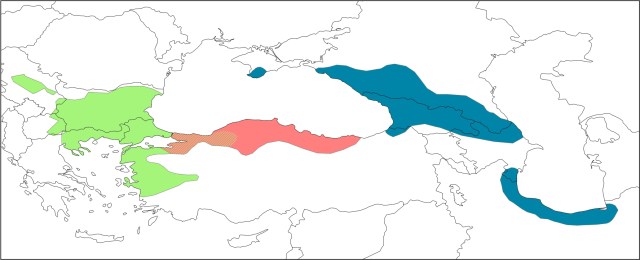
This ‘geophylogeny’ shows a mitochondrial DNA phylogeography for Triturus karelinii plotted on a map. Note that there are three distinct clades, with their approximate range in different shades of blue.

In a paper published in Molecular Phylogenetics and Evolution, we present a range-wide mitochondrial DNA phylogeography. We show that T. karelinii is a monophyletic group that comprises three very distinct, geographically structured lineages. They are as different from one another as recognized crested newt species are. We also provide a historical biogeographical scenario to explain the origin of these lineages.

Paleo

In the paper we explain the origin of the genetic variation in T. karelinii in the context of the paleogeology of Eurasia.

Reference: Wielstra, B., Espregueira Themudo, G., Güclü, Ö., Olgun, K., Poyarkov, N.A., Arntzen, J.W. (2010). Cryptic crested newt diversity at the Eurasian transition: the mitochondrial DNA phylogeography of Near Eastern Triturus newts. Molecular Phylogenetics and Evolution 56(3): 888-896.

Posted in Uncategorized | 2 Comments