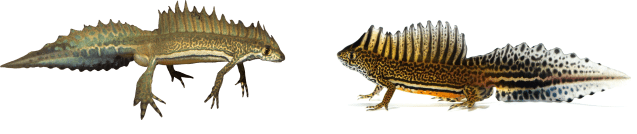
A crested newt enclave predicts species replacement

Species with a very similar ecology compete with each other and in nature such species generally exclude one another. Their distribution ranges do not overlap but are adjacent to each another and meet at parapatric contact zones. The position of these contact zones is not necessarily stable. If one species has a slight competitive advantage, it would gradually replace the other species. However, this process occurs at a slow pace and hence is difficult to observe directly. In a paper published in Proceedings of the Royal Society of London B: Biological Sciences we use a crested newt case to show how past range dynamics can be inferred from present-day distribution patterns.

Species with abutting ranges sometimes show a peculiar distribution pattern, where a section of one species’ range is enveloped by that of the other. We argue that such an enclave can originate when a species is replaced by a competitor in part of its range, but endures locally while the invading species moves around and past it. Hence, an enclave can be used as an indicator of past species replacement. Several enclaves are known in Triturus newts.

18 Enclave cartoonA scenario in which an enclave is created via incomplete species replacement. A green species expands to the right and replaces a blue one. However, a relict population of blue persists locally within the green range. If the two species hybridize, a genomic footprint of hybrid zone movement would be expected in the part of the green range that was formerly occupied by the blue species (on the right side of the grey dotted line).

Because parapatrically distributed species are generally closely related, they often hybridize (and this is certainly the case in crested newts). Species replacement with hybridization equates to hybrid zone movement. Because a key prediction of hybrid zone movement is that the receding species leaves behind alleles in the species that supplants it, we can test the hypothesis that a crested newt enclave results from species replacement, by looking for a genomic footprint of hybrid zone movement.

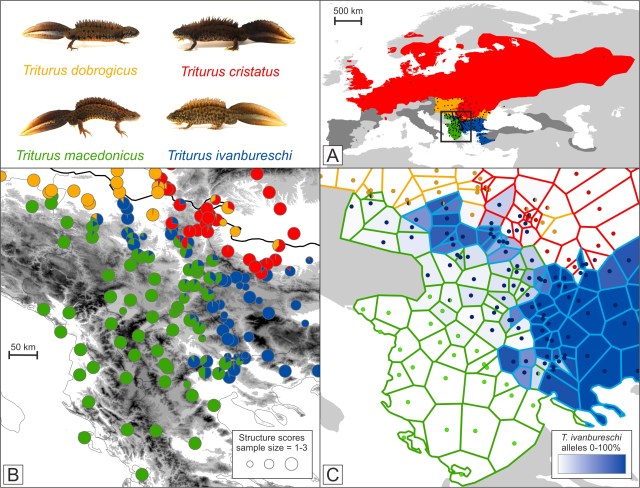
We provide proof of concept by studying a crested newt enclave situated in Serbia. By screening dozens of genes, we uncover genetic remnants of the species inhabiting an enclave, in the range of an infringing species. This independent evidence from genetics confirms the past distribution dynamics that the enclave predicted: an expanding crested newt species intersected the range of a receding one. Our findings underline the predictive power of enclaves for inferring past species replacement.

18 Enclave newts.jpgIn panel A the range of the genus Triturus is shown, with approximate outlines of the ranges of the four species under study shown in color (ranges of additional Triturus species are in dark grey). Dots are sampled localities. The box delineates part of the Balkan Peninsula, highlighted in the other panels. In panel B pie diagrams illustrate the average genetic composition per locality, with pie slices colored according to species. In panel C each polygon represents a locality and includes the area that is closest to that locality, rather than another one. The border of each polygon is colored according to the genetically dominant species. The blue shading of polygons reflects the proportion of alleles that are diagnostic for the crested newt species with the enclave (T. ivanbureschi) at that locality. Finally, the dots reflect the actual position of each locality and are colored according to the type of mitochondrial DNA present. What this admittedly rather complicated picture shows is that a blue enclave (belonging to the species T. ivanbureschi) is disconnected from the main range because the range of a green species (T. macedoncius) intervenes. In the part of the range of the green species where we expect that it replaced the blue species, we find genetic traces of that blue species, just as we predicted.

Reference: Wielstra, B., Burke, T., Butlin, R.K., Arntzen, J.W. (2017). A crested newt enclave predicts species replacement. Proceedings of the Royal Society of London B: Biological Sciences 284(1868): 20172014.

Reference: Wielstra, B., Arntzen, P. (2018). Schuivende hybridezones in kamsalamanders: hybridezones blijken beweeglijker dan gedacht. RAVON 20(4): 64-67.

newton_mc
I initiated this work as a Newton International Fellow. This project has received funding from the European Union’s Horizon 2020 research and innovation programme under the Marie Skłodowska-Curie grant agreement No. 655487.
Posted in Uncategorized | 3 Comments

Carpathian ‘refugia-within-refugia’: evidence from two newts

In Europe, the distribution ranges of many species were pushed back to the Mediterranean region during glacials, the cold phases of the Pleistocene Ice Age. While the climate in present day temperate Europe deteriorated, species managed to survive in Mediterranean refugia, where conditions remained agreeable. When the next interglacial arrived, and the climate ameliorated as is the case in the current Holocene, species could recolonize temperate Europe. It is increasingly realized that some regions north of the Mediterranean region also remained habitable for species favoring a temperate climate. Arguably, the Carpathians were the most important of these ‘northern glacial refugia’. The Carpathians did not merely allow species to weather glacial periods. Recent studies suggest that a mosaic of habitat types was present and some species may have persisted in multiple range fragments. This pattern has been well-documented for the Mediterranean region. The phrase ‘refugia-within-refugia’ was coined to describe a scenario in which species survive and diverge in multiple discrete glacial refugia.

15 Tcri Lmon.JPG

In a paper published in the Biological Journal of the Linnean Society we test whether the refugia-within-refugia scenario applies to the Carpathians for both a crested and a smooth newt species. As predicted, geographical genetic variation originated during, rather than after, the Pleistocene. Confirmation of refugia-within-refugia in these two ecologically distinct newt species suggest that the refugia-within-refugia scenario probably applies for quite some additional Carpathian species as well. Our findings emphasize the key role that the Carpathians played in Pleistocene survival and radiation of temperate Eurasia’s biodiversity.

Reference: Wielstra, B., Zieliński, P., Babik, W. (2017) The Carpathians hosted extra-Mediterranean refugia-within-refugia during the Pleistocene Ice Age: genomic evidence from two newt genera. Biological Journal of the Linnean Society 122(3): 605–613.

newton_mc
I initiated this work as a Newton International Fellow. This project has received funding from the European Union’s Horizon 2020 research and innovation programme under the Marie Skłodowska-Curie grant agreement No. 655487.
Posted in Uncategorized | 1 Comment

Biogeography of banded newts

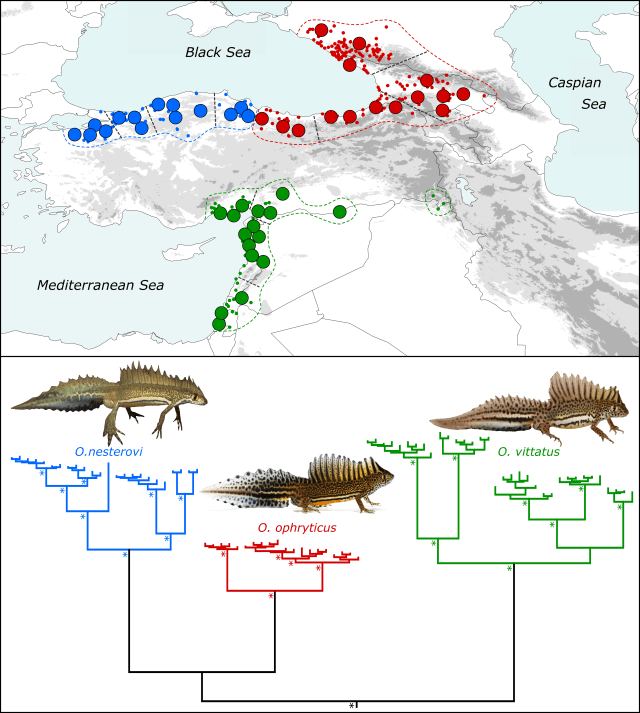
Banded newts (the genus Ommatotriton) are stunning critters. They are also distributed in a biologically fascinating, but relatively understudied region: the Near East. All the more reason to work on them, you would say. However, an in depth study on the historical biogeography of banded newts was lacking so far. There is not even consensus on how many species of banded newt there are! A banded newt phylogeography is the subject of the first paper from the thesis of my PhD student Isolde van Riemsdijk, now published in Molecular Phylogenetics and Evolution.

14

We confirm that there are three genetically distinct banded newt species, albeit relationships among these species remain unclear. One of the species, O. vittatus, is geographically completely isolated from the other two, O. nesterovi and O. ophryticus. While it seems likely that O. nesterovi and O. ophryticus meet in nature, it seems that there is little to no gene flow between the two species. The split between the three species is old, and genetic structure within species is ancient as well. The banded newt phylogeography highlights what an important region the Near East is form the perspective of biodiversity.

Reference: van Riemsdijk, I., Arntzen, J.W., Bogaerts, S., Franzen, M., Litvinchuk, S.N., Olgun, K., Wielstra, B. (2017). The Near East as a cradle of biodiversity: a phylogeography of banded newts (genus Ommatotriton) reveals extensive inter- and intraspecific genetic differentiation. Molecular Phylogenetics and Evolution 114: 73-81.

MC NWO
This project has received funding from the European Union’s Horizon 2020 research and innovation programme (under the Marie Skłodowska-Curie grant agreement No. 655487) and the ‘Nederlandse organisatie voor Wetenschappelijk Onderzoek’ (NWO Open Programme 824.14.014).


Posted in Uncategorized | 6 Comments

A genomic footprint of hybrid zone movement in crested newts

Where recently diverged species meet in nature, they often hybridize and exchange genes. The regions where this genetic intermingling occurs are called hybrid zones. If one member of a hybridizing pair of species displaces the other, their hybrid zone would in consequence move. For hybrid zones studied over decades, little shifts have occasionally been observed ‘live’. Of course a decade is next to nothing on an evolutionary time scale and over thousands of years a hybrid zone could potentially travel a considerable distance. Yet, theory predicts that moving hybrid zones quickly stabilize at barriers of less suitable habitat (so-called density troughs). So what’s the deal?

13A male crested newt from a hybrid pond.

A key prediction of hybrid zone movement is that selectively neutral genes of the displaced species introgress into the expanding one en masse, while gene flow in the opposite direction is negligible. In effect the receding species leaves behind a trail of genes within the advancing species. Such a ‘genomic footprint’ of hybrid zone movement could be uncovered by screening dozens of genes. To conduct this test of long-term movement, we had better study a hybrid zone for which a shift in position is likely to begin with. Triturus provides: we previously hypothesized that in Turkey the recently recognized T. anatolicus has been expanding at the expense of T. ivanbureschi, as their hybrid zone moved to the west. Using the Ion Torrent protocol we sampled a lot of newts from many localities throughout the range of both species.
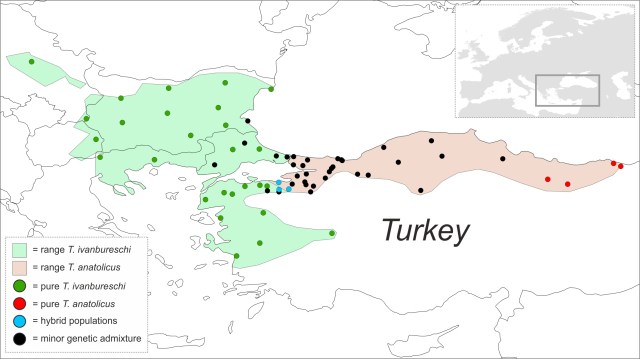
13aThe ranges of the two crested newt species are shown green and red. Pure green or red dots are populations where animals are genetically pure and the blue dots are hybrid populations (with genes of both species at high frequency). Black dots represent populations of one species where genetic traces of the other are present. Black dots are much wider distributed in the red than in the green species.

In a paper just published in the new journal Evolution Letters, we show that introgression between the two crested newt species is strongly biased. As predicted, we find considerably more genes of T. ivanbureschi in T. anatolicus then the reverse. This asymmetric introgression spans an extensive area. Our findings provide powerful evidence for a scenario in which T. anatolicus has been displacing T. ivanbureschi, while the two hybridized in the process. Theory be damned, the crested newt case strongly suggests that hybrid zone movement can proceed over considerable time and space! Hybrid zones are probably much more mobile than currently appreciated.

13bWhen plotting the fraction of genetic material derived from each species (ancestry) vs. the fraction of genes that posses a copy of either species (heterozygosity), a pure ‘green species’ would turn up in the lower left and a pure ‘red species’ in the lower right corner, while an F1 hybrid between the two species would end up in the upper corner. Plotted individuals are more widely spread in the lower right than in the lower left corner. This means that there are much more red individuals that possess some green genes, rather than the other way around.

Reference: Wielstra, B., Burke, T., Butlin, R.K., Avcıc, A., Üzüm, N., Bozkurt, E., Olgun, K., Arntzen, J.W. (2017). A genomic footprint of hybrid zone movement in crested newts. Evolution Letters 1 (2): 93-101.

Reference: Wielstra, B., Arntzen, P. (2018). Schuivende hybridezones in kamsalamanders: hybridezones blijken beweeglijker dan gedacht. RAVON 20(4): 64-67.

newton_mc
I initiated this work as a Newton International Fellow. This project has received funding from the European Union’s Horizon 2020 research and innovation programme under the Marie Skłodowska-Curie grant agreement No. 655487.
Posted in Uncategorized | 6 Comments

Detecting alien newt alleles

In the Netherlands we have a situation where the introduced Italian crested newt is locally replacing the native Northern crested newt. As the Northern crested newt is a threatened species, conservationists would like to try and remove Italian crested newts from the wild. A complication is that the two species hybridize and backcross, resulting in a mix of individuals that are hard to distinguish from natives based on morphology, but that do possess alien alleles. Genetic approaches are required to identify such newts.

ABL

Example for one of the nuclear markers genotyped with our ‘SNPline’ protocol. During PCR two differently fluorescence-labelled tags can be built in, one matching the native allele and the other matching the alien allele. The axes here reflect the level of fluorescence after PCR for each tag. The red cloud reflects individuals with two native copies and the blue cloud individuals with two alien copies, while the green cloud consists of individuals that possess both a native and an invasive allele for this particular marker.

In a previous study we documented the Dutch situation using our Triturus Ion Torrent protocol. The aim of a follow-up study, now published in the journal Conservation Genetics Resources, was to use our existing knowledge on the newt case and design a quick, cheap and easy pipeline to genotype newts on a large scale. Hence, the data required to stop the gradual replacement of the Northern crested newt by the Italian crested newt can now be collected efficiently. Our methodology can also be applied to other cases where the Italian crested newt has been introduced inside the range of the Northern crested newt, known from the UK, Germany and the Swiss/France border.

Reference: Wielstra, B., Burke, T., Butlin, R.K., Schaap, O., Shaffer, H.B., Vrieling, K., Arntzen, J.W. (2016). Efficient screening for ‘genetic pollution’ in an anthropogenic crested newt hybrid zone. Conservation Genetics Resources 8(4): 553-560.

newton_mc
I initiated this work as a Newton International Fellow. This project has received funding from the European Union’s Horizon 2020 research and innovation programme under the Marie Skłodowska-Curie grant agreement No. 655487.
Posted in Uncategorized | 2 Comments

The Anatolian crested newt: a new species endemic to Turkey

11a map

The crested newt traditionally referred to as ‘Triturus karelinii‘ has been split into three species. This map shows their approximate ranges and type localities.

The crested newt species traditionally referred to as ‘Triturus karelinii’ has turned out to be a group of cryptic species. A range-wide mtDNA phylogeography revealed that this taxon comprises three mtDNA clades, as distinct from one another as recognized crested newt species are. To assess the biological meaning of the mtDNA results we subsequently analysed three nuclear DNA markers. The resulting dataset confirmed the existence of three distinct nuclear DNA groups: an eastern, a central and a western one.

There is no evidence for gene flow between the allopatric eastern group and the other two and, based on the type locality, we restricted the name T. karelinii sensu stricto to the eastern group. For the western plus central group the name ‘T. arntzeni’ has previously been used, but at its type locality only newts that show genetic admixture between (predominantly) T. macedonicus and the western group occur. Hence we proposed an alternative name, T. ivanbureschi (sensu lato), in which we placed both the western and central group for the time being.

image description

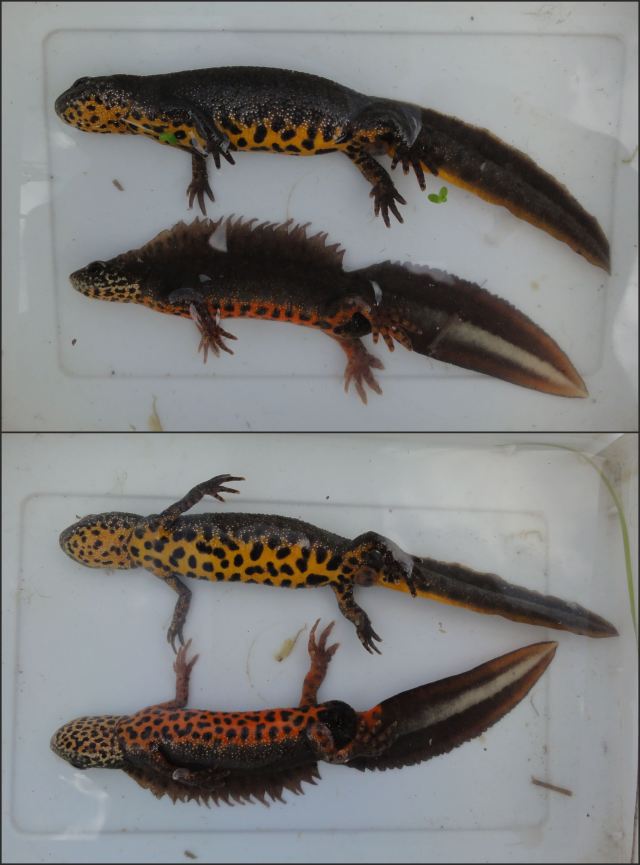
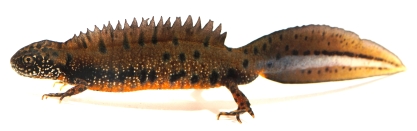
These sedated newts, a female above and a male below, are from the type locality of Triturus anatolicus.

The taxonomical question of whether the two groups comprising T. ivanbureschi sensu lato are different species remained. As the two occur in parapatry and show evidence of at least some recent gene flow, we preferred not to jump to conclusions. We first conducted a detailed hybrid zone analysis with the aid of the Triturus Ion Torrent protocol. Although not the main aim of the hybrid zone study (to be published separately) we could use the data to determine if the two groups comprising T. ivanbureschi should be regarded as distinct species. We could confirm that both groups comprising T. ivanbureschi sensu lato manage to maintain their genetic integrity. Because the type locality is positioned in the range of the western group, the name of T. ivanbureschi should be restricted to that group. We have now described the central group as a distinct species, dubbed T. anatolicus, in the journal Zootaxa. Up to now only genetic data have been used to identify the three crested newt species comprising the T. karelinii sensu lato group. The next step is to take a better look at these newts and see if morphological features that separate the species can be discovered.

11c type locality

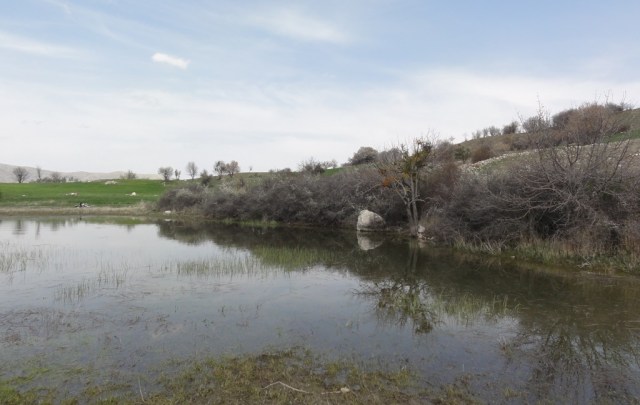
This pond is the type locality of Triturus anatolicus.

Reference: Wielstra, B., Arntzen, J.W. (2016). Description of a new species of crested newt, previously subsumed in Triturus ivanbureschi (Amphibia: Caudata: Salamandridae). Zootaxa 4109(1): 073-080.

newton_mc
I initiated this work as a Newton International Fellow. This project has received funding from the European Union’s Horizon 2020 research and innovation programme under the Marie Skłodowska-Curie grant agreement No. 655487.
Posted in Uncategorized | 1 Comment

No subspecies for the Danube crested newt

T.dobrogicus_Danube DeltaMale T. dobrogicus. Picture by Michael Fahrbach.

The taxonomical history of Triturus has been (and is) a turbulent one. However, genetic data has been very helpful in clearing it up. After our recent taxonomical revision of the genus, all species in the genus were considered monotypic except for one: in the Danube crested newt (T. dobrogicus) two subspecies were still recognized. But was this justified? No strong evidence was published in favour and recent work in fact seemed to disagree with this treatment. To settle the matter once and for all we turned to the power of the Triturus Ion Torrent protocol. After testing for the presence of intraspecific genetic structuring we could only conclude that there was none, or at least none that would fit the two subspecies hypothesis. Hence, in a recent paper in Amphibia-Reptilia, we suggest to treat the Danube crested newt as monotypic as well. Nice and tidy.

Reference: Wielstra, B., Vörös, J., Arntzen, J.W. (2016). Is the Danube crested newt Triturus dobrogicus polytypic? A review and new nuclear DNA data. Amphibia-Reptilia 37(2): 167-177.

newton-logo

I conducted this work as a Newton International Fellow.
Posted in Uncategorized | Leave a comment

Genetic pollution in Dutch crested newts

Invasive species threaten native biota, not only through competition, predation and infection, but also via hybridization. Human-induced hybridization has important implications from the point of view of conservation as it results in genetic replacement – a loss of biodiversity at the level of the gene. However, because hybridizing species are often closely related and morphologically similar, ‘genetic pollution’ is insidious. To expose and quantify genetic pollution, genetic data need to be consulted.

In several localities within the range of the threatened Northern crested newt (Triturus cristatus), the Italian crested newt (T. carnifex) has been introduced. In the Netherlands T. carnifex has established itself on the Veluwe and poses a potential threat there to the native T. cristatus. At the request of the Invasive Alien Species Team,  my MSc. student Willem Meilink and I, in collaboration with the Dutch NGO RAVON (Reptile, Amphibian and Fish Conservation Netherlands), used the new Triturus Ion Torrent protocol to explore the issue of genetic pollution of T. cristatus by T. carnifex. We recently published a paper in Biological Conservation on the case. Populations vary from completely invasive, via different degrees of genetic admixture, to completely native, when sampling outwards from the initial site of introduction of the exotic species. The observed pattern shows that the two crested newt species are hybridizing on the Veluwe and that the exotic T. carnifex is expanding at the expense of the native T. cristatus.

This figure shows the study area with eleven studied ponds (above) and the genetic composition of twelve individuals sampled for each pond (below). From pond 1 to 11 the proportion of genetic material of the invasive T. carnifex (blue) decreases, whereas that of the native, threatened T. cristatus (red) increases. The top panel also shows the distribution of mitochondrial DNA in the ponds (using the same color scheme); note that it underestimates the spread of T. carnifex.

This figure shows the study area with eleven studied ponds (above) and the genetic composition of twelve individuals sampled for each pond (below). From pond 1 to 11 the proportion of genetic material of the invasive T. carnifex (blue) decreases, whereas that of the native, threatened T. cristatus (red) increases. The top panel also shows the distribution of mitochondrial DNA in the ponds (using the same color scheme); note that it underestimates the spread of T. carnifex.

Our study shows that the invasive species poses a threat to the native species through genetic pollution. However, countering this threat, if one would decide to do so, is far from straightforward. Which individuals deserve protection? How to deal with individuals with an almost native genotype? What is the legal status of such individuals? Even when you have made a decision, how will you establish in practice whether a particular individual meets your requirement? Are there instances where you should consider maintaining genetic integrity of the native species infeasible? What if most individuals have become polluted? Tackling these dilemmas requires interaction between scientists, conservationists, legislators and land managers. We hope this case study will help drafting as yet non-existent guidelines for the management of genetic pollution.

This study was funded by the Invasive Alien Species Team, which advices the Ministry of Economic Affairs on the management of invasive species, and it was conducted in collaboration with the Dutch NGO RAVON (Reptile, Amphibian and Fish Conservation Netherlands), responsible for monitoring amphibians (and reptiles and fish) in the Netherlands.

Reference: Meilink, W.R.M., Arntzen, J.W., van Delft, J.C.W., Wielstra, B. (2015) Genetic contamination of a native threatened crested newt species through hybridization with an invasive congener. Biological Conservation 184: 145-153.

Reference: Wielstra, B., Arntzen, P., van Delft, J., Meilink, W. (2015). Genetische vervuiling op de Veluwe: hybridisatie tussen een inheemse en een exotische kamsalamandersoort. RAVON 17(2): 36-39.

Reference: Meilink, W.R.M., Arntzen, J.W., Wielstra, B. (2013). Genetische vervuiling op de Veluwe: Hybridisatie tussen de inheemse Noordelijke kamsalamander en de invasieve exoot Italiaanse kamsalamander. Naturalis Biodiversity Center, Leiden.

newton-logo

I conducted this work as a Newton International Fellow.
Posted in Uncategorized | 5 Comments

Two notes on the Kosswig’s newt

Last spring Emin Bozkurt and I were conducting fieldwork in Turkey. Although we were specifically targeting crested newts, we came across many Lissotriton newts as well. We were quite surprised to catch some paedomorphic Kosswig’s newts (Lissotriton kosswigi). Paedomorphism is the retention by adults of traits normally seen only in juveniles. In newts this constitutes keeping the gills into adulthood and having a fully aquatic lifestyle rather than spending a chunk of the year on land. It is not unexpected that paedomorphism occurs in the Kosswig’s newt, considering that paedomorphism has been reported for most of the Kosswig’s newts cousins, but paedomorphic Kosswig’s newts had never been documented before. Hence, we published a note in the Turkish Journal of Zoology about our encounter.

9aFrom top to bottom these are a normal adult male, a paedomorphic male, a paedomorphic female and a normal adult female Kosswig’s newt. Notice the gills of the paedomorphs. The male shows a swollen cloaca, meaning it is sexually mature and hence an adult.

Reference: Bozkurt, E., Olgun, K., Wielstra, B. (2015). First record of facultative paedomorphism in the Kosswig’s newt Lissotriton (vulgaris) kosswigi (Freytag, 1955) (Urodela; Salamandridae), endemic to northwestern Turkey. Turkish Journal of Zoology 39: 976-980.

The Kosswig’s newt and its Turkish congener the Schmidtler’s newt have always fascinated me. The reason for this is that they show a similar biogeographical pattern to crested newts. For both groups of newt a relatively recent shift of distribution ranges, in response to a re-arrangement of the marine connection between the Black and Marmara Seas, is strongly suspected. The advantage of the Lissotriton newts is that they are morphologically quite distinct, whereas for crested newts we (as yet) have to rely on genetics for species identification. On top of the comparative biogeographical pattern, the Kosswig’s newt has a very limited distribution range and its species status is not generally accepted. In this context we wrote a paper on the distribution and taxonomy of all the Turkish Lissotriton newts for Zookeys.

The Kosswig’s (top) and Schmidtler’s newt are quite different. The crest is smooth and starts above the forelimbs in the Kosswig’s newt and is ragged and starts in the neck in Schmidtler’s newt. The Kosswig’s also differs from the Schmidtler’s newt in having a threadlike tail filament and very flappy feet.

Reference: Wielstra, B., Bozkurt, E., Olgun, K. (2015). The distribution and taxonomy of Lissotriton newts (Amphibia, Salamandridae) in Turkey. ZooKeys 484: 11-23.

Please note that newts normally do not pose for pictures like the ones above; these newts were temporally sedated.

newton-logo

I conducted this work as a Newton International Fellow.
Posted in Uncategorized | 3 Comments

A crested newt refugium in the Carpathians

The current Pleistocene Ice Age has heavily influenced the distribution of species. One could argue it still does – the Ice Age is not a thing of the past, we are now merely experiencing a relatively warm interval (called the Holocene). During an Ice Age, the climate cycles between long cold spells (glacial periods) and short warm spells (interglacials) and this temperature fluctuation is larger, further away from the equator. During the glacial periods many species had their ranges reduced in so-called glacial refugia, where conditions remained agreeable (whereas populations outside these areas went extinct). During interglacials they could expand their distributions again from these glacial refugia. This pattern of range reduction and expansion repeated itself with each climate cycle.

The three southern European peninsulas – Iberian, Italian and Balkan – played a major part as glacial refugia. Many temperate species had their ranges reduced to one of these peninsulas during glacial periods and colonized the rest of their European from here as glacial conditions alleviated. The Carpathians are now increasingly being recognized as a relatively northern glacial refugium.

The three southern European peninsulas – Iberian, Italian and Balkan – played a major part as glacial refugia. Many temperate species in Europe had their current ranges reduced to one of these peninsulas during glacial periods and they colonized the rest of their current range from here as glacial conditions alleviated. The Carpathians are now increasingly being recognized as a relatively northern glacial refugium.

In stable populations in glacial refugia genetic diversity accumulates over time and, when they get isolated from one another, such populations diverge. On the other hand, postglacially established populations typically arise from a few founders that represent only a fraction of the total genetic variation present in a species. Hence, population stability and expansion leave different signatures in a species’ genes across its range. The late Godfrey Hewitt, thinking from a northern hemisphere perspective, dubbed this pattern “southern richness and northern purity”.

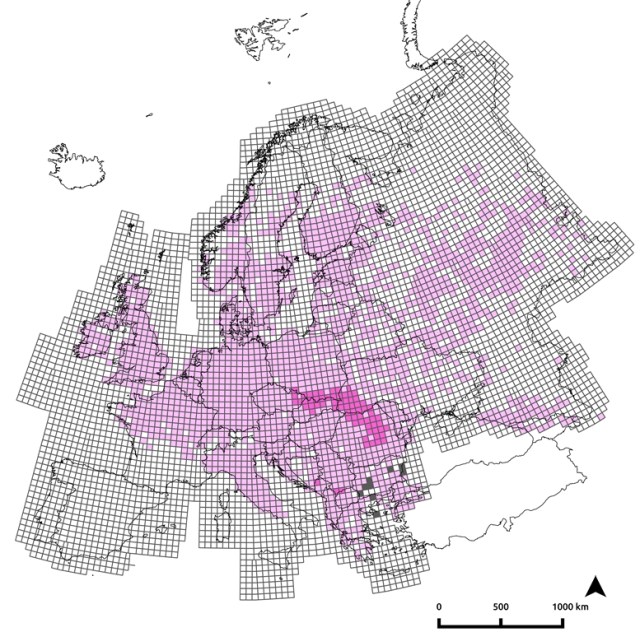
The genetic diversity for T. cristatus is high in the Carpathian region (two lower panels; mitochondrial DNA (left) and nuclear DNA show three main genetic groups, populations in grey are genetically admixed with other crested newt species). However, genetic diversity is basically zero in the rest of its range (top panel; one genetic group only). In the lower panels the Carpathian mountain range is shaded grey.

The genetic diversity for T. cristatus is high in the Carpathian region (two lower panels; mitochondrial DNA (left) and nuclear DNA show three main genetic groups, represented by different colors; populations in grey are genetically admixed with other crested newt species). However, genetic diversity is basically zero in the rest of its range (top panel; one genetic group only). In the lower panels the Carpathian mountain range is shaded grey.

As we strongly suspected that the crested newt Triturus cristatus provides a particularly extreme example of the “southern richness and northern purity” paradigm, we conducted a detailed screening of genetic diversity and investigated the distribution of suitable habitat at the height of the last glaciation. Several distinct genetic clusters occur in the Carpathians nowadays, whereas in the rest of its range T. cristatus shows extreme genetic depletion: newts from the UK and the Urals are indistinguishable based on the markers we studied! Most of the current range of T. cristatus was totally uninhabitable at the Last Glacial Maximum, but suitable area remained in the Carpathians. Our study, published in the Biological Journal of the Linnean Society, shows that most of the huge current range of T. cristatus was only colonized after the last glacial period ended, from a glacial refugium situated in the Carpathian region.

These ecological niche models show area predicted suitable for T. cristatus nowadays (top) and at the height of the last glacial period, the Last Glacial Maximum (c. 21,000 years ago).

These ecological niche models show area predicted suitable for T. cristatus nowadays (top) and at the height of the last glacial period, the Last Glacial Maximum (c. 21,000 years ago).

Reference: Wielstra B, Babik W, Arntzen JW (2015). Postglacial recolonization of Europe by the crested newt Triturus cristatus from an extra-Mediterranean glacial refugium – the Carpathian region. Biological Journal of the Linnean Society 114(3): 574-587.

newton-logo

I conducted this work as a Newton International Fellow.

Continue reading

Posted in Uncategorized | 12 Comments